Top Difficult Courses in the World for International Students: The 2026 Difficulty Index
Last Updated: June 17, 2026 | Reading Time: 13 minutes | Author: Pratik Jain, CEO, Reknown Edu Services®
Quick Answer: The most difficult course in the world for international students, ranked by dropout rates and cognitive load, is Aerospace Engineering (40-45% dropout rate), followed closely by Medicine (up to 35-45% pre-med pipeline attrition) and Quantum Physics/Astrophysics (35-40% dropout rate). While these degrees require up to 45 hours of weekly study beyond classes, they act as powerful filters yielding the highest starting salaries ($75,000-$110,000+) and maximum career ROI.
Why Difficulty Matters in Degree Selection
The hardest degrees in the world are not just academic challenges, they are filters for the highest-paying, most resilient careers. When you survive a program that eliminates 40 to 60% of entrants, you signal to employers: I can handle pressure, complexity, and sustained intellectual demands.
At Reknown Edu Services®, we have guided students through degree selection for various study abroad programs. The pattern is unmistakable: graduates of the most difficult courses command starting salaries 30 to 50% above average, face lower unemployment rates during recessions, and advance to leadership positions faster.
This guide ranks the most difficult course in the world options for international students, not by reputation, but by measurable outcomes: dropout rates, weekly study hours, cognitive load, and career ROI.
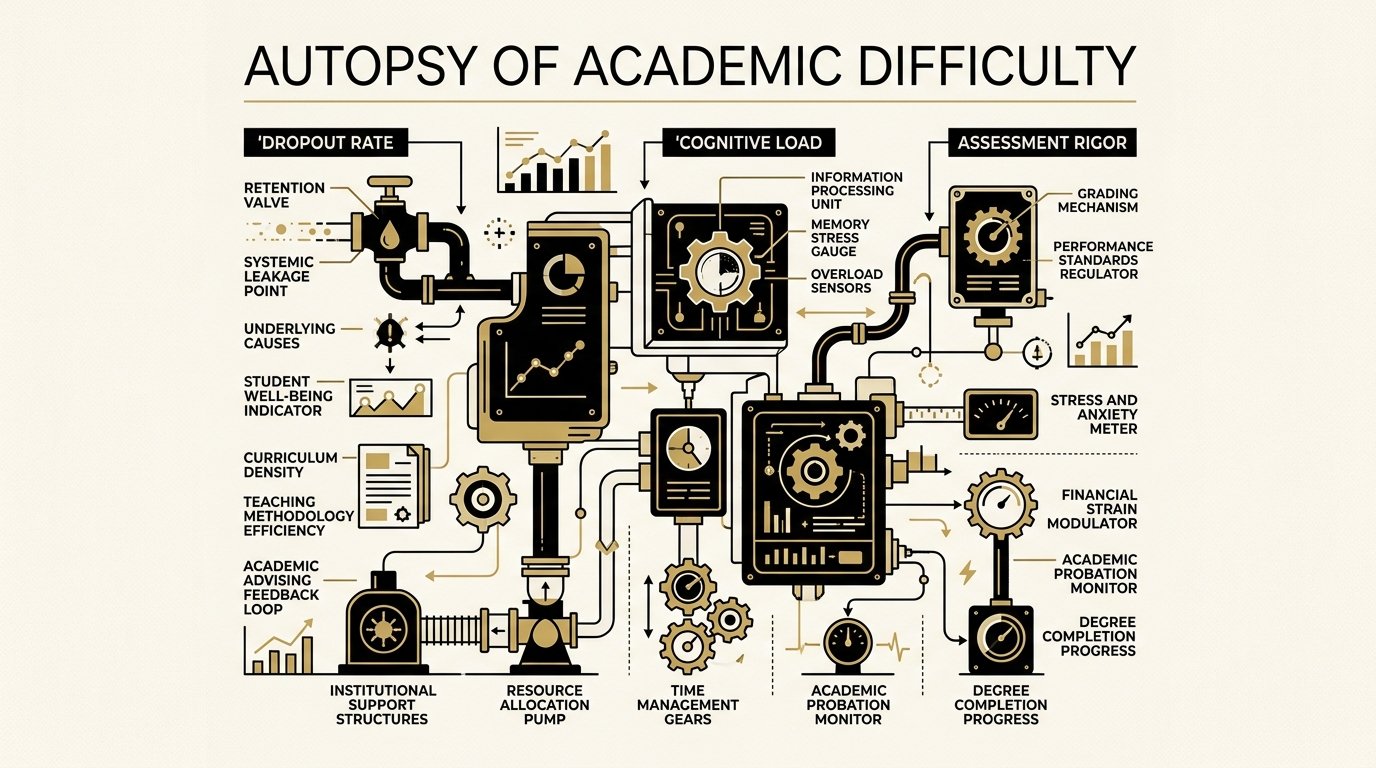
The Difficulty Index: How We Rank the World's Toughest Degrees
| Factor | Weight | Measurement |
|---|---|---|
| Dropout Rate | 25% | % of students who do not complete |
| Weekly Study Hours | 20% | Hours beyond class time required |
| Cognitive Load | 20% | Abstract reasoning, memorization, problem-solving demands |
| Assessment Rigor | 20% | Exam difficulty, project complexity, peer competition |
| Career ROI | 15% | Starting salary, employment rate, advancement speed |
Tier 1: The Extreme: Dropout Rates Above 40%
1. Aerospace Engineering
| Metric | Detail |
|---|---|
| Dropout Rate | 40 to 45% |
| Weekly Study Hours | 35 to 45 |
| Core Challenges | Multivariable calculus, fluid dynamics, thermodynamics, structural analysis |
| Best Universities | MIT, Caltech, Imperial College London, TU Delft, IIT Bombay |
| Starting Salary (Global) | $75,000-$110,000 |
Why it tops the list: Aerospace Engineering demands mastery of physics, mathematics, and materials science simultaneously. A single design error can cost lives and billions. The cognitive load, visualizing 3D stress distributions, optimizing fuel flow, calculating orbital mechanics, exceeds virtually every other discipline.
For international students: The most difficult Courses for International Students compound technical complexity with language barriers. Non-native English speakers must master technical terminology while absorbing abstract concepts. Programs at TU Delft (Netherlands) and RWTH Aachen (Germany) offer English-taught options with strong industry pipelines to Airbus, Boeing, and ESA.
2. Quantum Physics / Theoretical Physics
| Metric | Detail |
|---|---|
| Dropout Rate | 40 to 45% |
| Weekly Study Hours | 40 to 50 |
| Core Challenges | Abstract mathematics, counterintuitive concepts, no visual intuition |
| Best Universities | MIT, Caltech, Oxford, Cambridge, ETH Zurich, TUM |
| Starting Salary (Research) | $60,000-$90,000; (Industry: $100,000-$150,000) |
The intellectual Everest: Quantum physics requires accepting that reality operates fundamentally differently from human intuition. Wave-particle duality, entanglement, superposition, these are not analogies but mathematical truths. Students who struggle with linear algebra and differential equations fail quickly.
Career paradox: Academic positions are scarce and competitive. But industry demand for quantum computing specialists (IBM, Google, Microsoft) is exploding. A PhD in quantum physics from ETH Zurich or TUM now commands $200,000+ starting salaries in quantum computing roles.
3. Medicine (MBBS/MD)
| Metric | Detail |
|---|---|
| Dropout Rate | While US MD programs have 3-7% attrition, the broader pre-med to MD pipeline sees 35-45% of students not completing the journey |
| Weekly Study Hours | 50 to 60 (including clinical rotations) |
| Core Challenges | Memorization volume, emotional stress, sleep deprivation, life-or-death decisions |
| Best Universities | Harvard, Johns Hopkins, Oxford, Karolinska Institute, AIIMS |
| Starting Salary (Residency) | $55,000-$65,000; (Post-residency: $200,000-$400,000+) |
The endurance test: Medicine is not intellectually the most demanding, it is the most sustained. Six years of undergraduate + medical school, 3 to 7 years residency, and lifelong continuing education. The emotional toll of patient suffering, malpractice liability, and 80-hour work weeks destroys candidates who entered for prestige or parental pressure.
For international students: US and UK medical schools rarely accept international applicants. Consider Germany (free tuition, 6-year programs, growing English-taught options), Australia (strong for Indian students), or Eastern Europe (lower costs, EU-recognized degrees).
Tier 2: The Severe: Dropout Rates 25: 40%
4. Architecture
| Metric | Detail |
|---|---|
| Dropout Rate | 30 to 35% |
| Weekly Study Hours | 40 to 55 (studio culture demands all-nighters) |
| Core Challenges | Design creativity + structural engineering + artistic expression + client management |
| Best Universities | MIT, ETH Zurich, Bartlett (UCL), TU Delft, IIT Kharagpur |
| Starting Salary | $50,000-$70,000 |
The creative-technical tightrope: Architecture students must simultaneously master structural load calculations, material science, historical design theory, and digital rendering, then produce original creative work weekly. Studio critiques are brutal public evaluations that destroy students unused to creative vulnerability.
5. Computer Science / Artificial Intelligence (Top Programs)
| Metric | Detail |
|---|---|
| Dropout Rate | 25 to 35% (at elite programs) |
Ready to take on the world's best courses?
Don't leave your admission to chance. Get a Priority Profile Audit today.
Book Profile Audit| Metric | Detail |
|---|---|
| Weekly Study Hours | 30 to 40 (plus 20+ hours self-directed coding) |
| Core Challenges | Abstract algorithms, mathematical proofs, rapid technology obsolescence |
| Best Universities | CMU, Stanford, MIT, ETH Zurich, IIT Bombay, NUS |
| Starting Salary (Top Graduates) | $120,000-$250,000 |
The moving target: Computer science at elite programs is not just hard, it is accelerating. A curriculum designed in 2022 is partially obsolete by 2026. Students must self-teach emerging frameworks (PyTorch, LangChain, Mojo) while mastering foundational theory (algorithms, complexity, systems design).
The international student advantage: Unlike medicine or law, CS is meritocratic and visa-friendly. STEM OPT in the USA, Global Talent Visa in the UK, and EU Blue Card in Germany create clear pathways for top graduates.
6. Law (Juris Doctor / LLB at Elite Programs)
| Metric | Detail |
|---|---|
| Dropout Rate | 15 to 20% |
| Weekly Study Hours | 35 to 45 |
| Core Challenges | Case law memorization, Socratic method, competitive grading curves |
| Best Universities | Harvard, Yale, Oxford, Cambridge, LSE, NLSIU Bangalore |
| Starting Salary (Big Law) | $190,000-$250,000 (US); £100,000+ (UK Magic Circle) |
The Socratic grinder: Elite law programs use the Socratic method, professors cold-call students to dissect cases in front of peers. There are no right answers, only better arguments. Students who cannot think on their feet, under pressure, with incomplete information, fail.
For international students: US law degrees (JD) are rarely accessible to non-US citizens. UK law degrees (LLB, LLM) are more accessible but require conversion courses for practice. Consider German law (growing English-taught options) or Singapore (NUS Law is globally top 10).
Tier 3: The Demanding: Dropout Rates 15: 25%
7. Chartered Accountancy / Actuarial Science
| Metric | Detail |
|---|---|
| Dropout Rate | 15 to 25% |
| Weekly Study Hours | 25 to 35 (plus exam preparation cycles) |
| Core Challenges | Voluminous standards memorization, precision under time pressure, multi-year exam sequences |
| Best Institutes | ICAI (India), ICAEW (UK), SOA/CAS (USA), IFoA (UK) |
| Starting Salary | $50,000-$80,000; (Fellow: $150,000-$300,000+) |
The marathon: Actuarial science requires passing 7 to 10 exams over 5 to 10 years while working full-time. Each exam has 40 to 50% pass rates. The material, probability, financial mathematics, life contingencies, risk theory, is not conceptually impossible, but the volume and precision demands break candidates.
8. Pharmacy / Pharmacology
| Metric | Detail |
|---|---|
| Dropout Rate | 15 to 20% |
| Weekly Study Hours | 30 to 40 |
| Core Challenges | Biochemistry memorization, drug interaction complexity, clinical precision |
| Best Universities | Johns Hopkins, UCL, Monash, University of Toronto, NIPER (India) |
| Starting Salary | $70,000-$90,000 |
The detail obsession: A 0.1mg dosing error can kill. Pharmacy students must memorize thousands of drug interactions, contraindications, and side effect profiles, then apply this knowledge in high-pressure clinical settings.
9. Nursing (BSc Nursing / MSN)
| Metric | Detail |
|---|---|
| Dropout Rate | 20 to 25% |
| Weekly Study Hours | 30 to 40 (including clinical shifts) |
| Core Challenges | Emotional labor, physical demands, shift work, life-or-death responsibility |
| Best Universities | Johns Hopkins, University of Pennsylvania, King's College London, UTS Sydney |
| Starting Salary (USA) | $60,000-$80,000; (Australia: AUD 70,000 to 90,000) |
The hidden difficulty: Nursing is underestimated because it is "caring work." In reality, it demands equal parts biomedical knowledge, physical stamina, emotional regulation, and split-second decision-making. The attrition is highest in emergency and ICU specializations.
For international students: Australia and Canada actively recruit Indian nurses. AHPRA (Australia) and NNAS (Canada) registration pathways are well-established. Starting salaries in Australia exceed ₹45 lakhs annually with strong PR pathways.
10. Chemical Engineering
| Metric | Detail |
|---|---|
| Dropout Rate | 20 to 25% |
| Weekly Study Hours | 30 to 40 |
| Core Challenges | Thermodynamics, reaction kinetics, process design, safety protocols |
| Best Universities | MIT, Caltech, ETH Zurich, IIT Bombay, TU Munich |
| Starting Salary | $75,000-$100,000 |
The systems thinking demand: Chemical engineers must optimize processes where changing one variable (temperature, pressure, catalyst concentration) affects dozens of others. The mathematics, partial differential equations, transport phenomena, is among the most complex in engineering.
The Strategic Choice: Should You Pursue a Difficult Degree?
| Your Profile | Recommendation |
|---|---|
| Strong in math/physics, high stress tolerance | Aerospace, quantum physics, chemical engineering |
| Strong in memorization, detail-oriented | Medicine, pharmacy, nursing |
| Creative + analytical, high work capacity | Architecture, computer science |
| Verbal reasoning, argumentation skills | Law |
| Long-term endurance, precision focus | Actuarial science, chartered accountancy |
FAQ: Difficult Courses for International Students
Q1: Do difficult degrees guarantee higher salaries?
Not automatically. But they create access to elite career tracks that average degrees cannot. The signal value of surviving a rigorous program opens doors that grades alone cannot.
Yes, strategically. STEM degrees (engineering, CS, nursing) receive priority in immigration systems worldwide. Australia's skilled occupation list, Canada's Express Entry, and Germany's EU Blue Card all favor technical and healthcare qualifications. Make sure to check our How to Choose University guide to match your profile to the right institution.
Q3: What if I start a difficult degree and realize I cannot handle it?
Most universities allow program transfers within the first year. The key is recognizing mismatch early, not after failing multiple courses. Speak with academic advisors and career counselors promptly.
Q4: Are online or hybrid versions of these degrees respected?
For technical degrees (CS, engineering), hybrid programs from accredited universities are increasingly accepted. For medicine, nursing, and law, in-person clinical training remains mandatory.