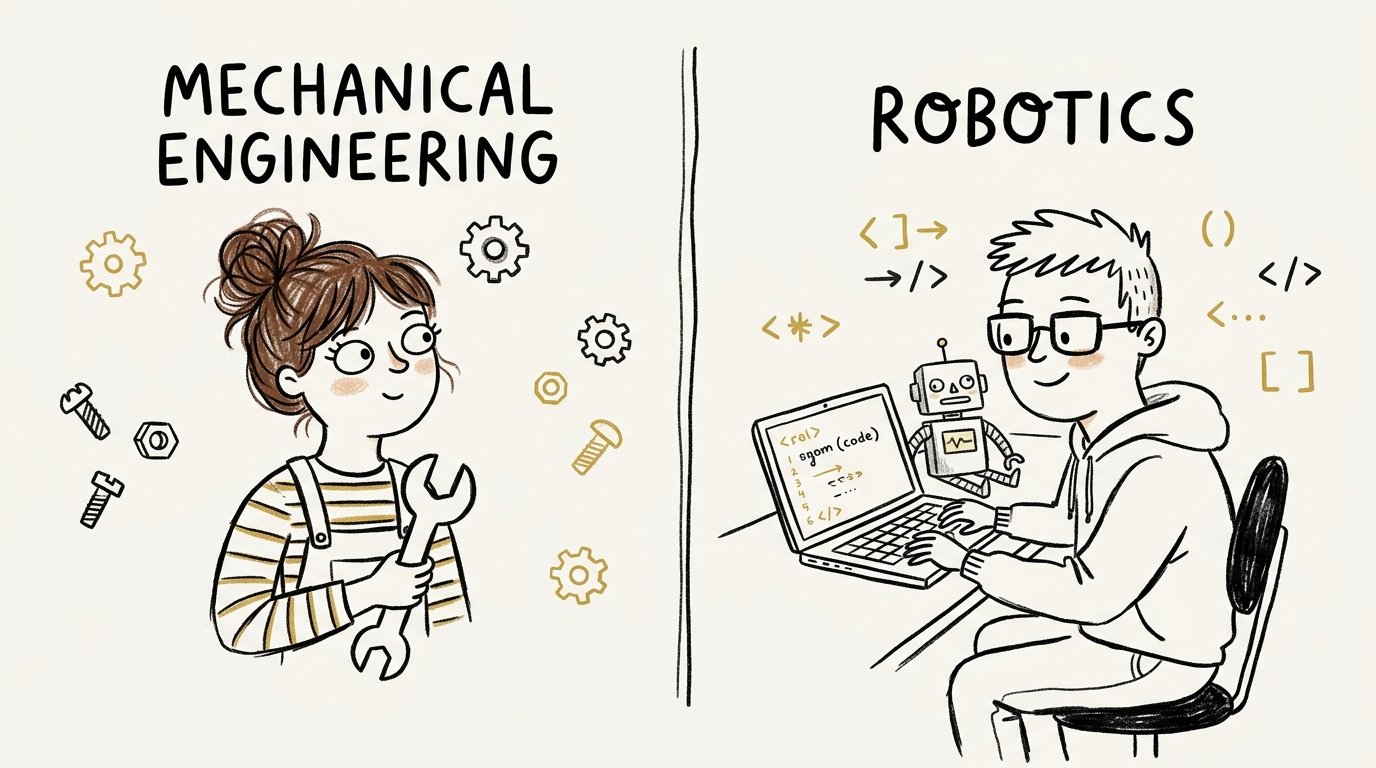
How We Evaluated Both Paths
Choosing a specialization is rarely about the field itself; it is about how the field aligns with your strengths, finances, and country of choice. We compared both options across six dimensions that matter most to international students:
- Curriculum fit with an Indian mechanical undergraduate background
- Hiring demand in destination countries (US, Germany, Canada, UK)
- Salary and ROI against typical master's tuition
- Immigration and PR pathways, including occupation shortage lists
- Saturation risk over a 10-year career horizon
- Switching cost if you decide to pivot mid-career
Weight these by your own priorities. A student funding the degree through education loans should weigh ROI and PR more heavily than someone with family funding.
Curriculum and Coursework
Mechanical engineering master's programs typically deepen your knowledge in thermodynamics, fluid mechanics, solid mechanics, manufacturing processes, and increasingly, computational modeling. Programs at universities like Georgia Tech or TUM integrate simulation tools, finite element analysis, and increasingly, mechatronics electives.
Robotics and automation programs, by contrast, sit at the intersection of mechanical, electrical, and computer science. Expect courses in kinematics, control theory, machine learning, computer vision, and the Robot Operating System (ROS). Programs like Carnegie Mellon's Robotics Institute assume comfort with linear algebra, probability, and at least one programming language.
Verdict: If you enjoyed your design and manufacturing labs, mechanical feels natural. If your favorite electives included programming, microcontrollers, or control systems, robotics will reward you faster. Students with weak coding backgrounds can still pivot, but expect a demanding first semester.
Hiring Demand and Engineering Career Prospects
The traditional view that mechanical engineering is saturated does not hold up against the data. The U.S. Bureau of Labor Statistics projects 9% growth for mechanical engineers from 2024 to 2034, with roughly 18,100 annual openings. The Canadian Job Bank projects 12,700 new positions through 2031, with a moderate shortage rating.
Robotics and automation hiring is harder to isolate because roles get classified under mechanical, electrical, or software engineering. However, the World Economic Forum Future of Jobs Report consistently ranks robotics engineers and AI specialists among the fastest-growing roles. Companies in AI-integrated manufacturing are hiring aggressively, and 75% of engineering firms predicted increased hiring in 2025.
Verdict: Mechanical wins on volume and breadth. Robotics wins on growth velocity and salary premium for specialized skills.
Salary, ROI, and Country-Specific Outlook
The BLS reports a median annual wage of $102,320 for mechanical engineers in the US (May 2024). Robotics engineers typically earn 10-25% more, depending on whether the role leans toward software or hardware. In Germany, mechatronics and automation engineers are in shortage-listed occupations, making visa sponsorship straightforward.
For Indian students, ROI depends heavily on tuition. A two-year US master's at $60,000-$90,000 needs a clear job pipeline. Germany remains the strongest ROI play because public universities charge nominal fees, and the embedded systems and automation job market is robust. Our guide to MS in embedded systems in Germany covers APS certification, scholarships, and the realistic job market.
Immigration and Long-Term Settlement
Both fields appear on shortage occupation lists in major destination countries, but the depth of demand differs. Mechanical engineers are listed on Canada's Express Entry categories and Australia's skilled migration list. The UK's Graduate Route remains a useful entry point; you can review pathways in our UK student living guide.
Robotics specialists often qualify under broader categories such as electronics or software engineering, which can actually widen your options. Germany's shortage occupation list explicitly includes automation roles, making it one of the most predictable PR pathways for engineers.