Home
Dmat Practice Questions
Back to Resources
Test Prep

dMAT Practice Questions 2027 with Answers

Pratik Jain12 min readLast updated

Listen to this article

Full read-aloud (12 min read) • Text highlights as it speaks

dMAT Latin square and figure sequence practice questions

Last Updated: October 28, 2026

QUICK ANSWER: What is in the dMAT Core Module? Three subtests: Figure Sequences, Mathematical Equations and Latin Squares. Each one has 20 tasks in 25 minutes, so about 75 seconds per task. You cannot take notes, and g.a.s.t. advises guessing when you do not know an answer. Practice questions for all three, with worked answers, are below.

The dMAT has two parts: the Core Module and a subject module. Indian applicants taking it for APS take the General Academic Module as their subject module. This page covers the Core Module, where practice makes the biggest difference: the task types never change, so once the rules are automatic, you get faster.

The practice questions below are our own, written in the same formats as the official examples in the g.a.s.t. preparation material. They are for practice. They are not real test questions. For full timed tests on screen, use our free dMAT mock tests.
How is the dMAT structured?

The dMAT has a Core Module with three subtests of 20 tasks each (25 minutes per subtest) and a subject module. For APS, Indian applicants take the General Academic Module, which has about 60 questions in 90 minutes. The exam takes about three hours, with a 30-minute break between the two parts.

PartSubtestTasksTimeTime per task
Core ModuleFigure Sequences2025 minutesabout 75 seconds
Core ModuleMathematical Equations2025 minutesabout 75 seconds
Core ModuleLatin Squares2025 minutesabout 75 seconds
Break30 minutes
Subject moduleGeneral Academic Module (for APS)about 6090 minutesabout 90 seconds

Rules that apply to the whole test:

  • All questions are single choice, with one correct answer.
  • You are not allowed to take notes during the exam. Everything is done in your head, on screen.
  • g.a.s.t. tells test takers to guess when they do not know an answer.
  • The test is taken digitally at a g.a.s.t. test centre. In India these include Bengaluru, Chennai, Mumbai, New Delhi, Pune and other cities.

Not being allowed to take notes is the biggest surprise for most students. Practise every question on this page without a pen.

Want an honest read on your study-abroad plan?

Book a free 30-minute session with Pratik. Know your profile score, program fit, and 90-day roadmap.

✓Since 2012 · Led by Pratik since 2016
✓Free next intake if an agreed shortlist gets zero offers (terms apply)
✓Direct access to Pratik, same strategist from day one to your visa, no juniors

How do Figure Sequences work?

You see a series of grids (matrices) with figures in them. The figures change position, colour or orientation from one grid to the next according to fixed rules. You find the rule and pick the next two grids. You have 25 minutes for 20 series.

The official rules, as published by g.a.s.t.:

  • Figures can change their colour.
  • Figures can rotate around their own axis.
  • Figures can move in the grid: vertically, horizontally or diagonally. A figure that moves diagonally does not switch to another type of movement.
  • A change can grow by one each time: a figure that moves 1 step, then moves 2 steps, then 3, and so on. The same applies to colour and rotation changes.
  • Figures cannot disappear or overlap.
  • Figures cannot leave the grid. At the edge they either bounce back or move along the outer boundary.

How to attack a series in 75 seconds

  1. Follow one figure at a time. Never try to track everything at once.
  2. For each figure, check movement first, then rotation, then colour.
  3. Check whether the step size is fixed (1, 1, 1) or growing (1, 2, 3).
  4. Work out the fifth and sixth grids figure by figure, then find the answer option that matches.

Look at grids M1 to M4, find the rule for each figure, then pick the option for M5 and for M6, as in the real test.

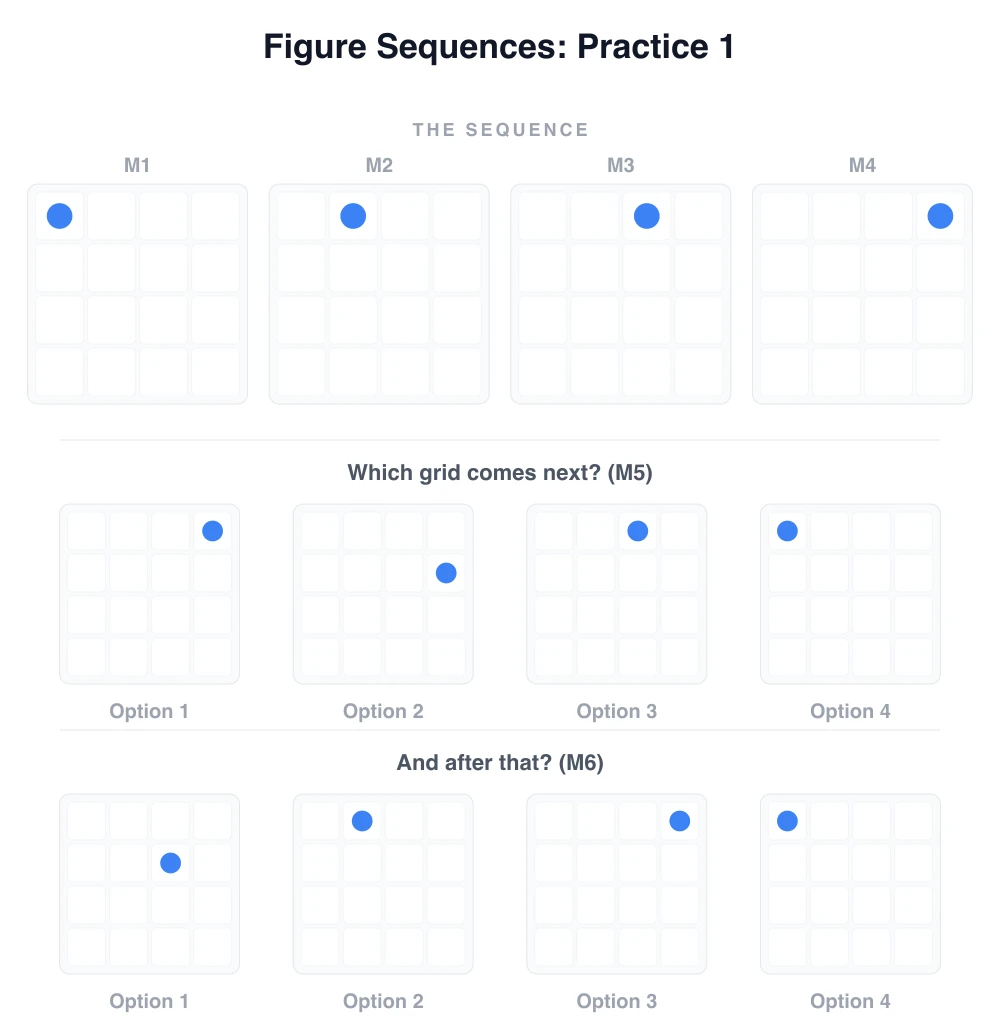
Practice 1 (one figure).

Figure sequence practice 1: a blue circle moving along the top row of a 4 by 4 grid

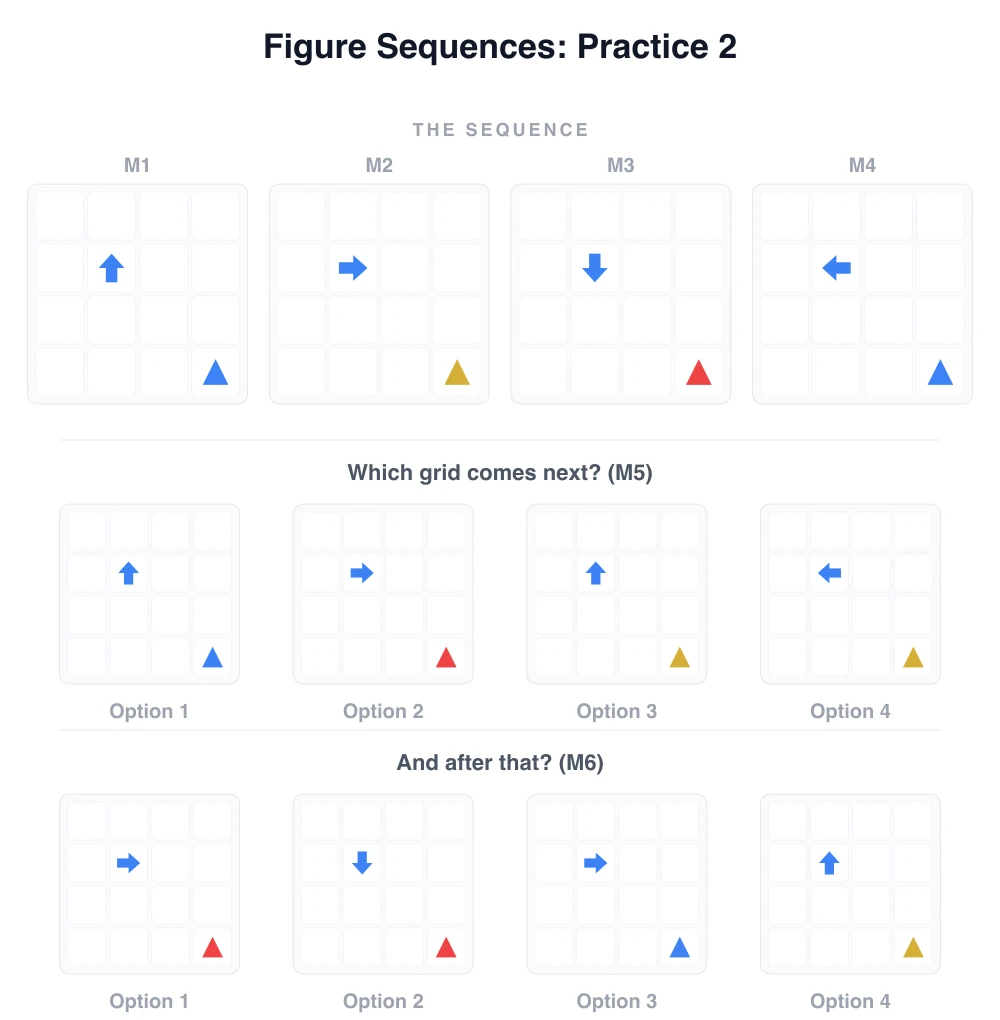
Practice 2 (two figures, two rules).

Figure sequence practice 2: a turning arrow and a triangle that changes colour

Practice 3 (harder: the step grows each time).

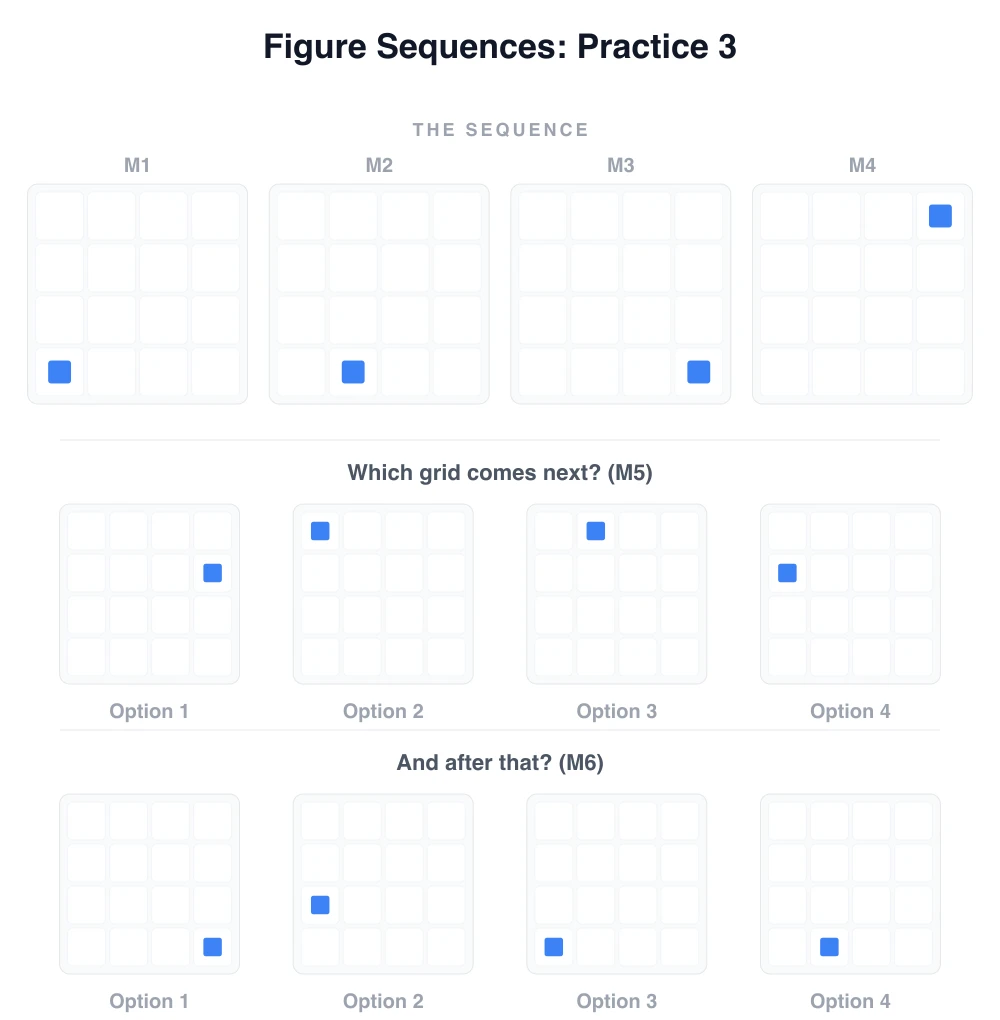
Figure sequence practice 3: a square moving around the edge of the grid with growing steps

Practice 4 (movement plus colour).

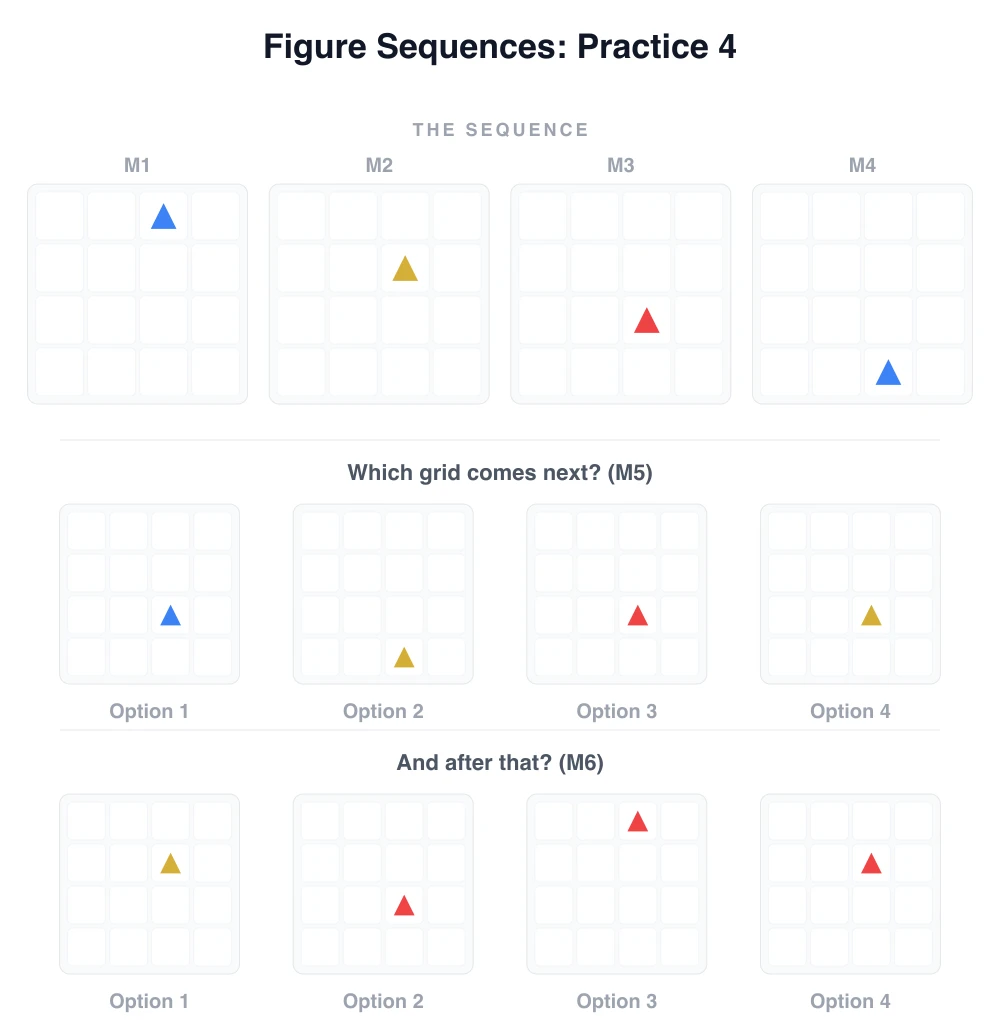
Figure sequence practice 4: a triangle moving down the grid and changing colour

Answers are at the end of this page.

How do Mathematical Equations work?

You get a small system of equations with letters. Each letter stands for a whole number from 1 to 20, and there is exactly one solution. You find the value of each letter. You have 25 minutes for 20 systems, without notes.

The fastest method is always the same: start from the equation that gives a letter directly (like B = 6), substitute it into the next equation, and keep going. If no letter is given directly, look for an equation that defines one letter in terms of another (like B = 2 × A) and substitute that.

Two checks save marks:

  • Every letter must be a whole number from 1 to 20. If you get 4.5 or 0, you have made a slip.
  • Put your answers back into every equation in your head before you move on. It takes five seconds.

Practice (no pen, aim for 75 seconds each):

Practice 1.

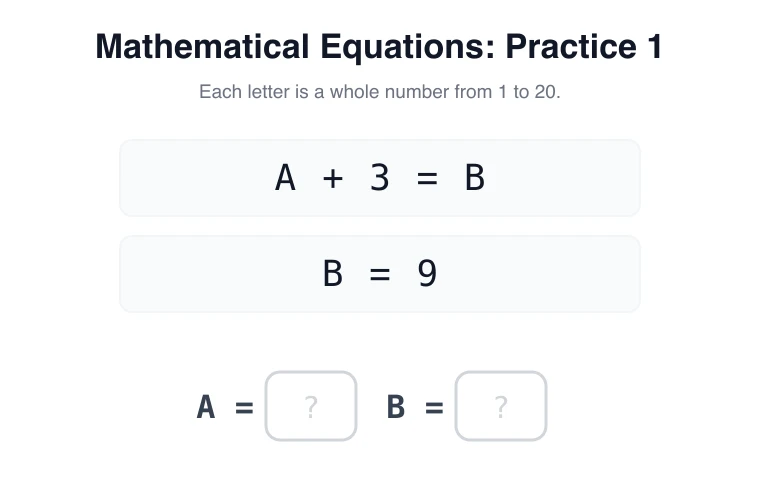
Equations practice 1: A + 3 = B, B = 9

Practice 2.

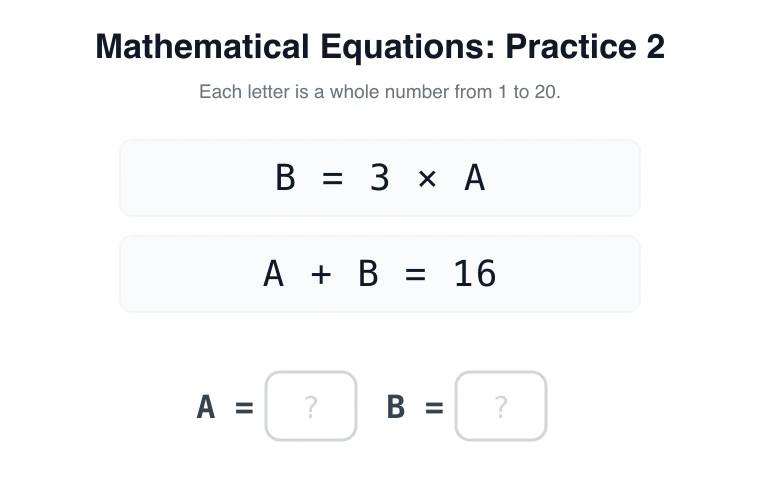
Equations practice 2: B = 3 × A, A + B = 16

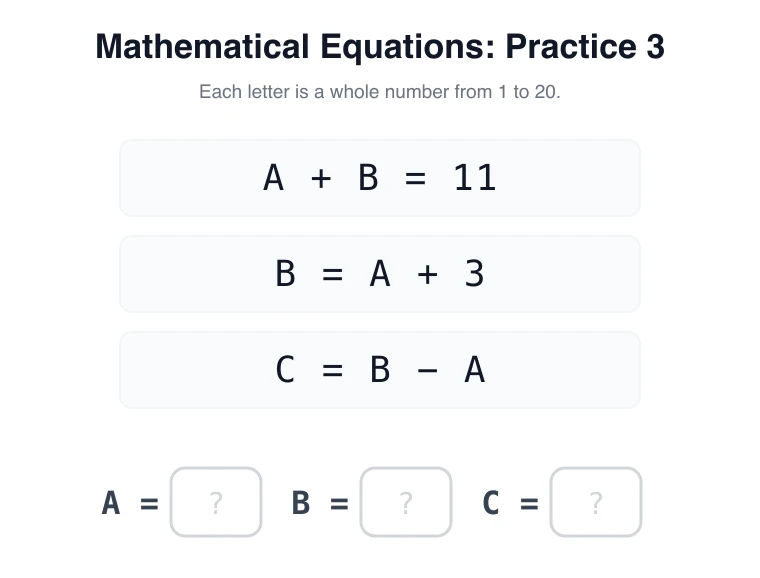
Practice 3.

Equations practice 3: A + B = 11, B = A + 3, C = B - A

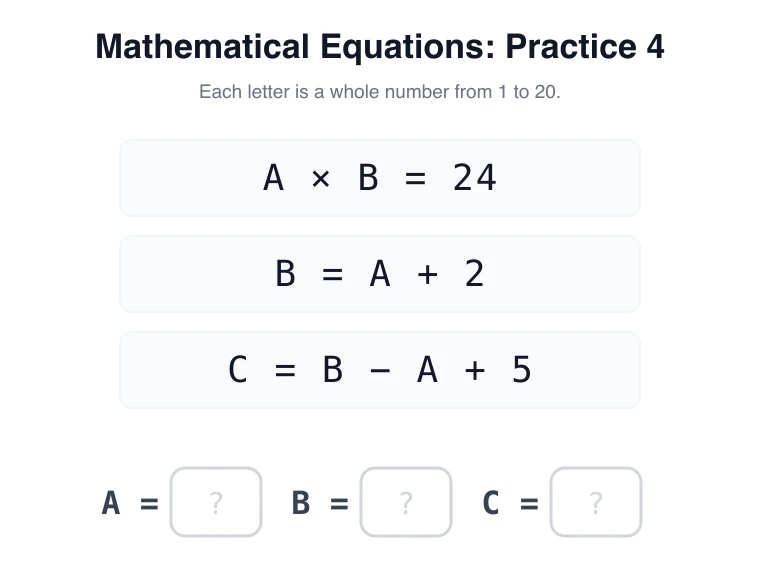
Practice 4.

Equations practice 4: A × B = 24, B = A + 2, C = B - A + 5

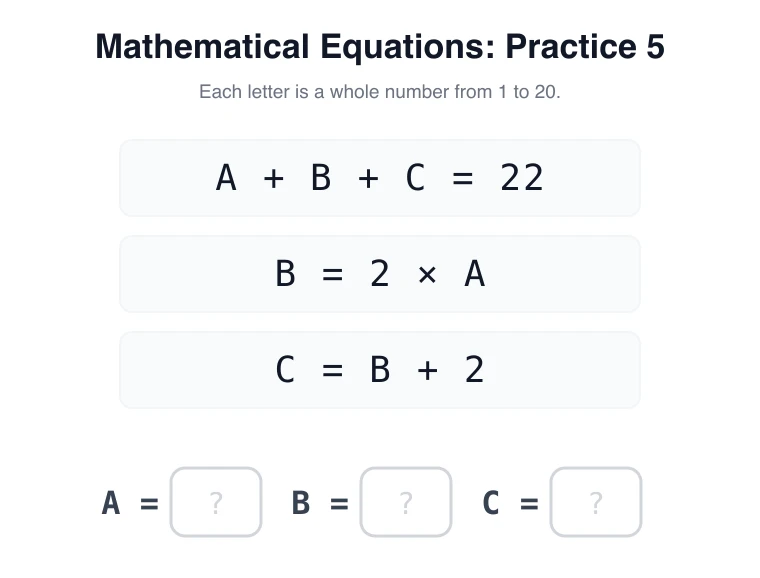
Practice 5.

Equations practice 5: A + B + C = 22, B = 2 × A, C = B + 2

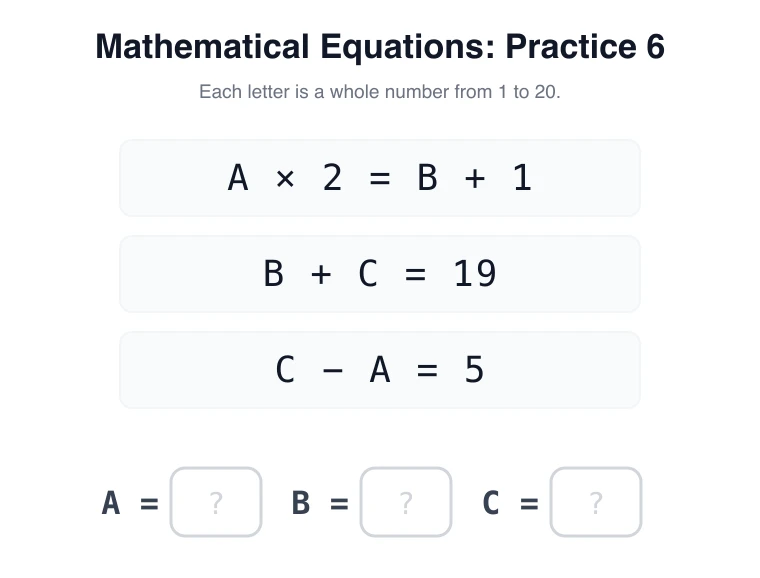
Practice 6.

Equations practice 6: A × 2 = B + 1, B + C = 19, C - A = 5

Answers are at the end of this page.

How do Latin Squares work?

You see a 5 by 5 grid with some letters filled in. Each letter can appear only once in each row and each column, and only the letters shown as answer options can be used. You work out which letter belongs where the question mark is. Sometimes you must fill other boxes in your head first. You have 25 minutes for 20 tasks.

In these practice grids the letters are A, B, C, D and E. Rows and columns are numbered 1 to 5, and the box to solve is highlighted.

Method

  1. Look at the question mark's row and column together. If four different letters already appear there, the fifth is your answer. This solves the easier tasks in seconds.
  2. If not, find an empty box in the same row or column that can be filled: one where four letters are already ruled out. Fill it in your head, then check the question mark again.
  3. Keep the chain short. If you are three steps in and still stuck, guess, flag it mentally and move on. One task is worth the same as any other.

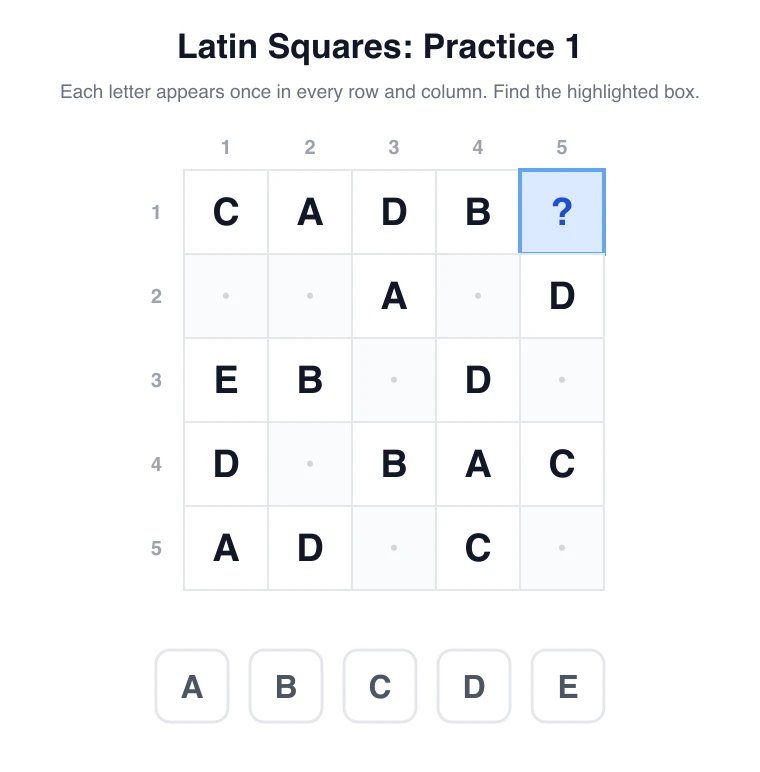
Practice 1 (easier). Which letter goes in the highlighted box?

Latin square practice 1: find the letter for row 1, column 5

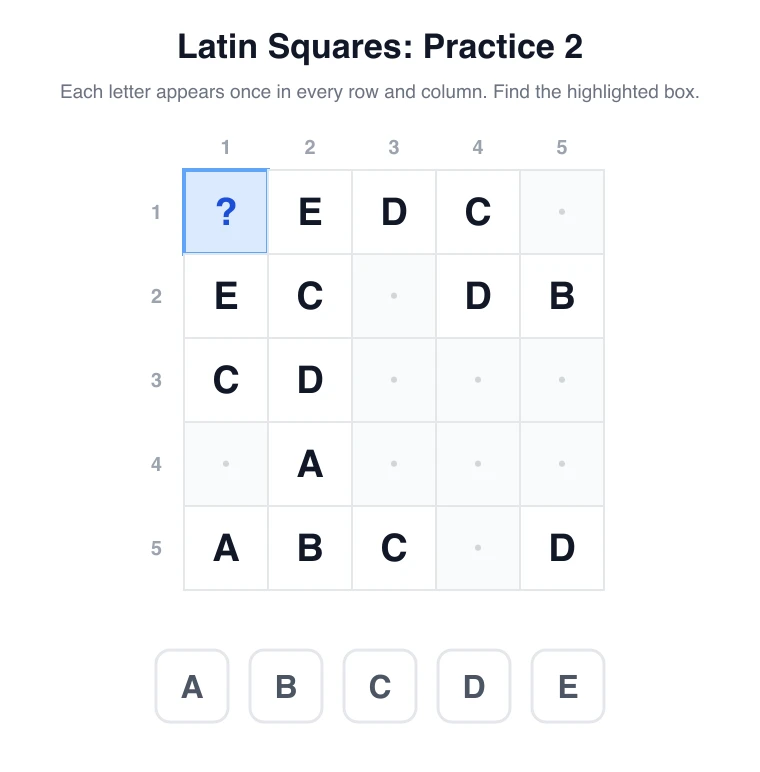
Practice 2 (easier). Which letter goes in the highlighted box?

Latin square practice 2: find the letter for row 1, column 1

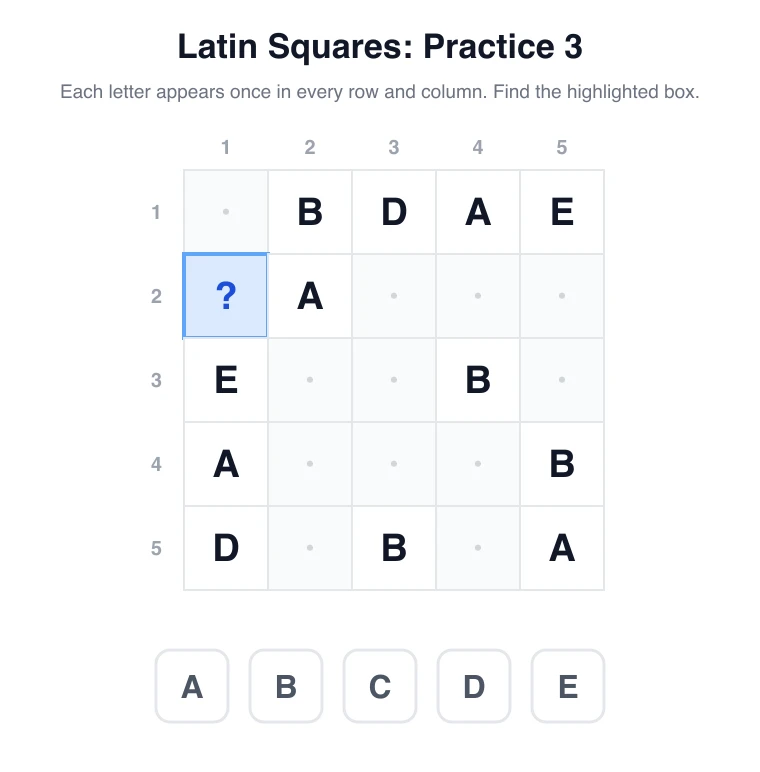
Practice 3 (harder). Which letter goes in the highlighted box?

Latin square practice 3: find the letter for row 2, column 1

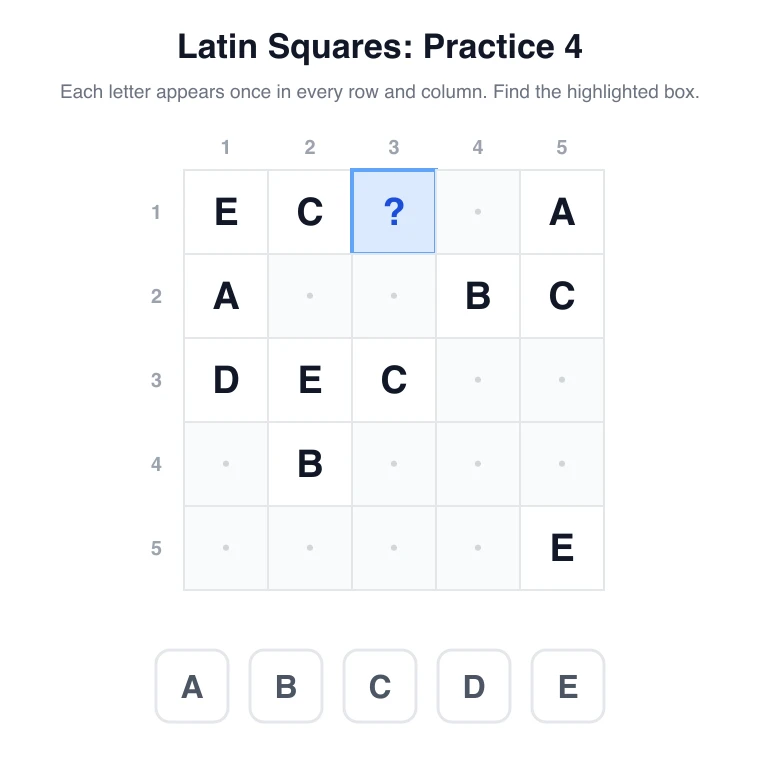
Practice 4 (harder). Which letter goes in the highlighted box?

Latin square practice 4: find the letter for row 1, column 3

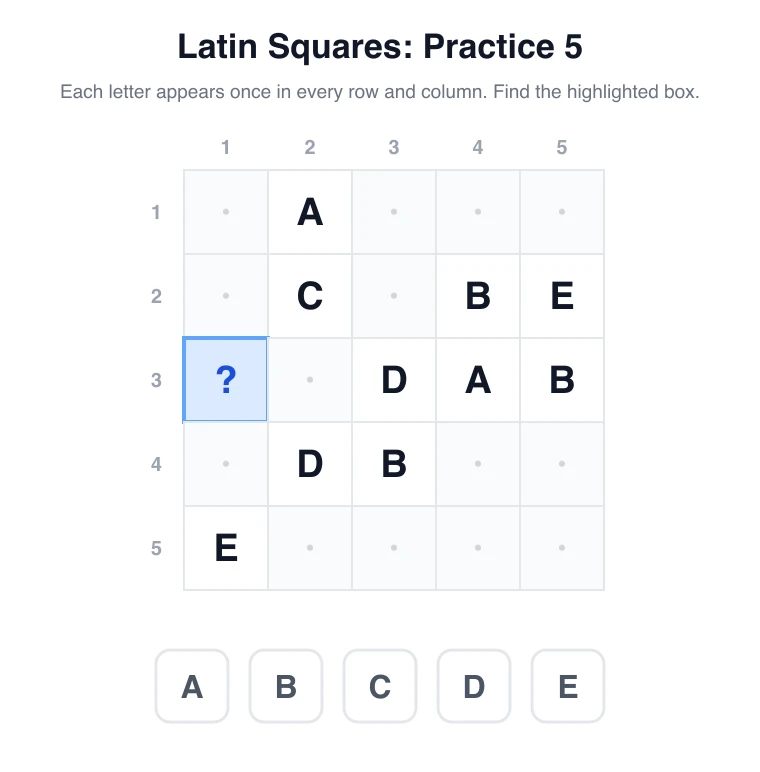
Practice 5 (harder). Which letter goes in the highlighted box?

Latin square practice 5: find the letter for row 3, column 1

Answers, with the steps, are at the end of this page.

What is the General Academic Module?

It is the subject module that Indian applicants take for APS. You read a text, which may include figures, tables or formulas, and answer single-choice questions with 4 options each. There are about 60 questions in 90 minutes. Topics can come from mathematics, computer science, natural sciences, engineering, business, economics, social sciences and humanities.

g.a.s.t. describes it as testing transfer and application, not memorised facts: you get a typical problem and use the information given to answer questions about it. The official preparation material includes four practice exercises for this module, and the demo version in the g.a.s.t. participant portal shows how the questions look on screen.

What helps most:

  • Read the questions before the long text, so you know what to look for.
  • Be comfortable reading simple tables and graphs quickly.
  • Practise basic school maths without a pen: percentages, ratios and reading a formula.

Our dMAT guide covers who has to take the test, the fee, registration and how the score is used.

📄

Free Guide: SOP Skeleton & 10 Critical Errors

Download our free 1-page PDF SOP framework we use with our students.

How is the dMAT scored?

Your certificate shows a percentile rank and a dMAT score. The dMAT score converts your number of correct answers to a scale from 0 to 200, with an average of 100. You get a separate score for the Core Module and the subject module, and the total is the two added together.

The percentile rank tells you what share of other test takers scored the same as you or lower. A percentile rank of 70 means 70% of test takers scored the same or lower and 30% scored higher.

For APS, there is no pass mark. APS India states that a low dMAT score does not automatically lead to a refusal of the APS certificate, and the dMAT result is shown on your APS certificate. Universities can use the score in their own admission decisions, so a better score can still help.

How should I prepare for the Core Module?

Learn the rules of each task type first, then practise without notes and against the clock: 75 seconds per task. Use the official g.a.s.t. preparation material and demo version, then full timed mock tests. Most students need two to four weeks of short daily practice.

A simple four-week plan:

WeekFocus
1Read the official instructions and examples for all three subtests. Do the practice on this page untimed, without a pen
210 tasks of each subtest per day, timed at 75 seconds per task
3One full timed mock test, then rework every task you missed
4Two more full mock tests, plus General Academic Module practice

Official material: the g.a.s.t. preparation PDF and on-screen introduction videos for each subtest are on the dMAT website, and the demo version is in your participant portal under "Exam Preparation". Our free dMAT mock tests give you full timed practice on screen.

Answers to the practice questions

Figure Sequences

  1. M5: Option 3, M6: Option 2. The circle moves one step right each time and bounces back off the right edge: column 3, then column 2.
  2. M5: Option 3, M6: Option 1. The arrow turns 90 degrees clockwise each time (up, right, down, left, so next up, then right). The triangle stays put and its colour repeats blue, gold, red (so next gold, then red).
  3. M5: Option 4, M6: Option 1. The step grows by one each time (1, 2, 3 steps), and at a corner the square follows the outer edge. 4 steps from the top-right corner take it along the top and one box down the left edge (row 2, column 1). 5 more steps take it to the bottom-right corner.
  4. M5: Option 4, M6: Option 4. The triangle moves one step down each time and bounces off the bottom edge (row 3, then row 2). Its colour repeats blue, gold, red (gold, then red).

Mathematical Equations

  1. A = 6, B = 9
  2. A = 4, B = 12
  3. A = 4, B = 7, C = 3
  4. A = 4, B = 6, C = 7
  5. A = 4, B = 8, C = 10
  6. A = 5, B = 9, C = 10

Latin Squares

  1. E. R1 C5 must be E, because the other four letters already appear in that row or column.
  2. B. R1 C1 must be B, because the other four letters already appear in that row or column.
  3. B. First, R1 C1 must be C, because the other four letters already appear in that row or column. Then R2 C1 must be B, because the other four letters already appear in that row or column.
  4. B. First, R1 C4 must be D, because the other four letters already appear in that row or column. Then R1 C3 must be B, because the other four letters already appear in that row or column.
  5. C. First, R2 C3 must be A, because the other four letters already appear in that row or column. Then R2 C1 must be D, because the other four letters already appear in that row or column. Then R3 C1 must be C, because the other four letters already appear in that row or column.

Ready for a full test? Our free dMAT mock tests have 3 full-length timed simulations on screen, with no signup required.

Frequently Asked Questions

Are these real dMAT questions?

No. They are our own practice questions, written in the same formats as the official examples published by g.a.s.t. Real test questions are not published.

Can I take notes in the dMAT?

No. g.a.s.t. states that you are not allowed to take notes during the exam, so practise solving every task in your head.

Should I guess on the dMAT?

g.a.s.t. advises test takers to guess when they do not know an answer. Do not leave a task unanswered.

How much time do I get per task in the Core Module?

Each Core Module subtest has 20 tasks in 25 minutes, which is about 75 seconds per task.

How many questions are in the General Academic Module?

About 60 questions in 90 minutes, according to g.a.s.t. The exact number can be slightly higher or lower.

Can I take the dMAT more than once?

Yes. g.a.s.t. states that you may take the dMAT as many times as you wish, and the certificate is generally valid indefinitely, although universities can set their own rules.

Pratik Jain

Pratik Jain

Study Abroad Strategist

Reknown Edu Services® has guided students abroad from Bengaluru since 2012. Every plan is personally reviewed by Pratik.

🎯 Guiding Students Since 2012🎓 Strategy-First Approach

Get an honest read on your profile (free)

Book a 30-minute session with Pratik. Know your profile score, program fit, and next 90 days.

So we can send a quick message or voice note.

~30 seconds. A real strategist replies within a few working hours. No spam, no cold calls.

✓Since 2012 · Led by Pratik since 2016
✓Free next intake if an agreed shortlist gets zero offers (terms apply)
✓Direct access to Pratik, same strategist from day one to your visa, no juniors