Home
Anabin Check Germany Degree Recognition
Back to Resources
Germany

Anabin Check: Will Germany Accept Your Indian Degree? (2026 Guide)

Pratik Jain10 min read
Indian student checking a university's anabin rating before applying to Germany

Last Updated: October 7, 2026

Some capable Indian applicants do everything right: IELTS, SOP, LORs, a polished CV. Then they run into a problem none of those documents can fix: Germany does not recognise their degree the way they assumed it would. The frustrating part is that this is checkable, for free, in minutes, before you spend a rupee on applications.

That check runs through one official tool that few people explain properly: anabin.


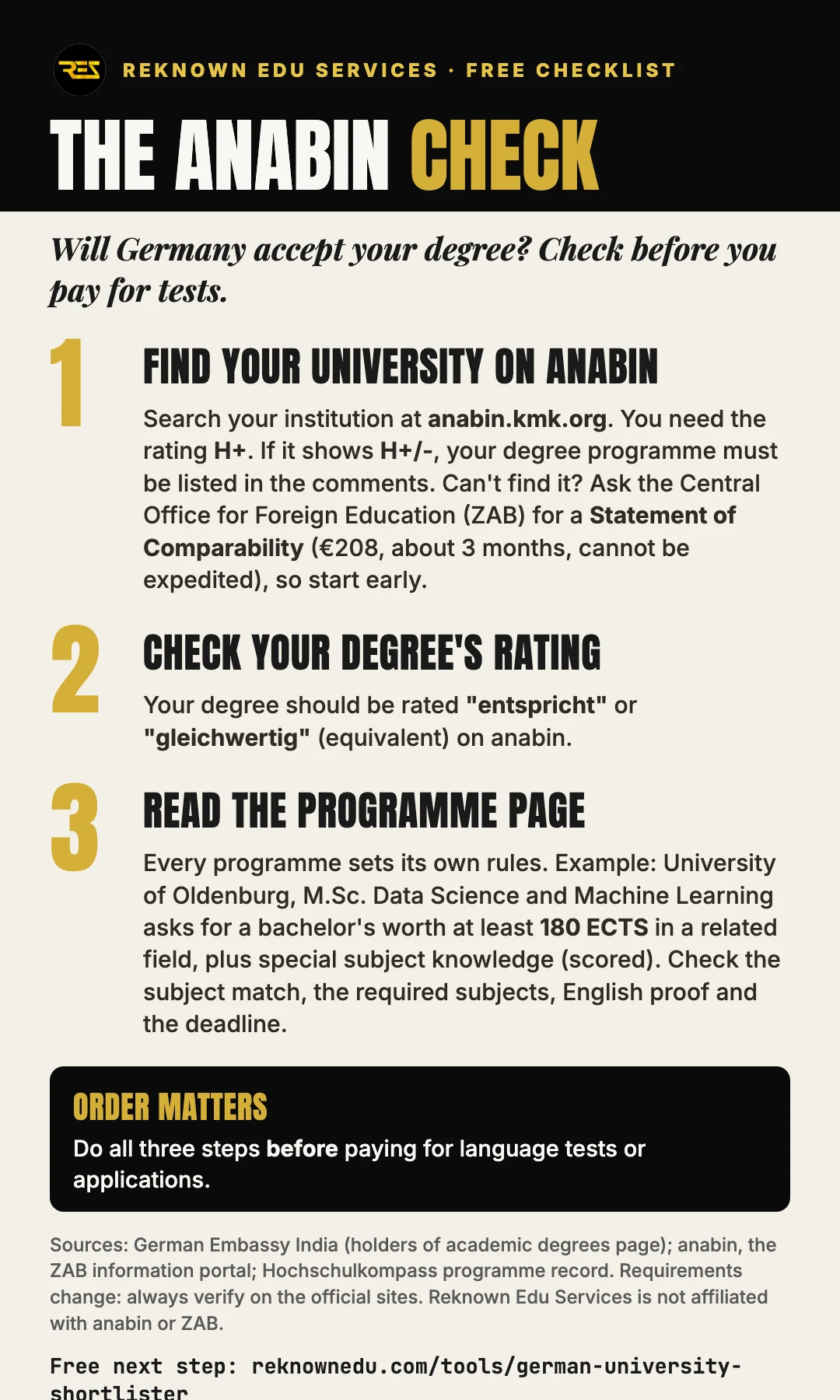
QUICK ANSWER: The 3-Step Anabin Check

  1. Check your institution: search your university on anabin. It needs the rating H+. If it shows H+/-, your degree programme must be explicitly listed in the comments for your university.
  2. Check your degree: your degree should be rated "entspricht" or "gleichwertig" (both mean it is treated as equivalent).
  3. Check the programme page: even with a good rating, each Master's programme sets its own ECTS and subject requirements. Anabin clears the gate. The programme page sets the bar.

Why This Check Matters: The Pattern We Keep Seeing

At Reknown Edu Services®, we read admissions threads and student documents continuously. One pattern repeats in that research (it comes from our own review of student forums and casework, not a published statistic): students often discover a recognition problem after paying for the process.

The typical sequence: ₹18,000 on APS (a non-refundable fee), weeks of document collection, uni-assist fees across a dozen applications (about €75 for the first and €30 for each extra one, so roughly €400 for twelve), and only then a rejection that points to degree equivalence or subject requirements. The intake is gone.

The cost of finding out late is not just money. It is the semester, the one thing in this process you cannot buy back. A few minutes on anabin before you start protects everything that comes after.

Want an honest read on your study-abroad plan?

Book a free 30-minute session with Pratik. Know your profile score, program fit, and 90-day roadmap.

✓1,500+ students guided by Pratik since 2012
✓Full refund if a jointly-agreed 3+ university shortlist gets zero offers
✓Direct access to Pratik, same strategist from day one to your visa, no juniors

What Is Anabin, Exactly?

Anabin is the German information portal on foreign education qualifications, published under the Standing Conference of the Ministers of Education (KMK). It is the reference database for how foreign institutions and degrees are classified.

Three things every Indian applicant should know:

  • It is the official tool. The German Embassy in India tells applicants to use anabin to check whether their university is recognised in Germany and how their degree is rated.
  • It is public and free to search. You will find it at anabin.kmk.org.
  • It does not decide admission. It tells you about recognition. Admission is still a separate, programme-level decision, which is why step 3 matters as much as steps 1 and 2.

Step 1: Check Your Institution's Rating

Search for your university by name on anabin. According to the German Embassy in India, your university must have a rating of H+.

StatusWhat it means for youWhat you do
H+Your university meets the requirementMove on to Step 2
H+/-Your university alone is not enoughYour degree programme must be explicitly listed in the comments for your university. If it is not listed, the check fails
Anything elseNot covered by the official guidance we foundGet professional advice before building a plan around this degree
Swipe to view

What if your university cannot be found? The embassy's guidance is to obtain a Statement of Comparability from the Central Office for Foreign Education (ZAB). Plan for this early. ZAB lists the fee as €208 and the processing time as about 3 months for a regular application, and states that an application cannot be expedited. A university may also ask for this statement as part of its own admission requirements. Check zab.kmk.org for the current fee and timing before you apply.

Step 2: Check Your Degree's Rating

Open your university's anabin entry and find your degree type. The German Embassy in India says your degree should be rated "entspricht" or "gleichwertig". Both are acceptable ratings, and both mean Germany treats your degree as equivalent.

If neither rating appears for your degree type, treat that as a warning sign and get advice before you pay for tests or applications.

What about 3-year and 4-year degrees? German-authority sources we reviewed in August 2026 indicate that a 4-year Indian B.E. or B.Tech is generally treated as a qualifying first degree, while a 3-year bachelor's (B.A., B.Sc., B.Com, BCA) is often not treated as directly equivalent to a German bachelor's and may need an additional qualification. Ratings are given per degree type, and programmes differ, so read your own entry and your target programme's page instead of assuming.

One more thing: German universities do not convert Indian credits into ECTS with a fixed multiplication formula. They assess your qualification as a whole (see "Common Mistakes" below).

Step 3: Check the Actual Programme Page

This is the step many applicants skip. Even a well-rated degree from an H+ university can be rejected by a specific programme, because each programme sets its own entry requirements on top of national recognition.

A real example: the University of Oldenburg's M.Sc. Data Science and Machine Learning (as listed on Hochschulkompass) asks for a bachelor's degree worth at least 180 ECTS in Data Science, Mathematics, Statistics, Physics, Computer Science, Business Information Systems or a closely related field, plus special subject knowledge, which is scored against the programme's admission regulations. It also has a local admission restriction, so meeting the minimum does not guarantee a place.

That one entry packs several separate checks:

How to Read a German Requirements Page

  1. Subject match: does your bachelor's field fall inside the programme's "related field" list? (German examination boards call this Fachrichtungsrelevanz, or subject relevance.)
  2. ECTS in the named subjects: a degree is not enough on its own. Programmes can ask for a set number of credits in specific subjects. Compare your transcript against the module list before applying.
  3. English proof: the exact test, the exact score, and whether it is needed at application or at enrolment.
  4. Deadline and selection process: is admission open (meet the requirements and you are in) or restricted (a ranked competition)? This changes your whole shortlist strategy.

Our German University Admission Timeline shows where this check sits in a full month-by-month plan, with a real case study of one applicant's 7 admits.

The Three Common Mistakes

Mistake 1: Applying before checking. Applicants treat anabin as a formality to verify "later". Later arrives as a rejection. The lookup takes minutes and costs nothing. No later date is cheaper than now.

Mistake 2: Assuming Indian credits get converted to ECTS. This is a persistent myth in study-abroad forums. According to the German-authority sources we reviewed (including uni-assist and university credit-transfer rules), universities do not multiply Indian credits by a fixed factor. They assess the qualification as a whole, using the anabin classification. ECTS are matched module by module only when credit transfer is applied for, and only where the competences match. So if a programme asks for 180 ECTS in a related field, you meet it through your degree's recognised status plus a real subject match, not by arithmetic on your transcript.

Mistake 3: Ignoring programme-level rules. A strong rating clears the national gate. It does not override what a specific examination board (Prüfungsausschuss) requires. Two programmes at the same university can give opposite answers to "will I get in?"

📄

Free Guide: SOP Skeleton & 10 Critical Errors

Download our free 1-page PDF SOP framework used by 600+ students admitted to top global universities.

A Worked Example (Fictional, for Illustration Only)

The profile: an example applicant (fictional, for illustration only) holds a 4-year B.Tech in Mechanical Engineering from an Indian state university, CGPA 7.4, and wants a Master's in Germany for the Winter 2027 intake.

Step 1: The applicant searches their university on anabin and sees H+. Gate cleared. (Had it shown H+/-, they would have checked whether their B.Tech programme is listed in the comments.)

Step 2: Their degree type is rated "gleichwertig", so Germany treats the B.Tech as equivalent. The CGPA converts to about 2.3 on the German scale using the Modified Bavarian Formula. You can check yours with our CGPA to German GPA Converter.

Step 3: They open the target programme's page and find: "related field required, 180 ECTS, basic knowledge in control engineering." Their transcript shows control systems and mechatronics electives, which is a match. Two other programmes on the list ask for programming credits the applicant does not have, so they drop them before paying uni-assist fees.

Result: they apply to ten well-matched programmes instead of twenty random ones. That is the point of the check.

Frequently Asked Questions

1. My university isn't listed on anabin. Am I ineligible? Not necessarily. The embassy's guidance is to obtain a Statement of Comparability from ZAB. It costs €208 and takes about 3 months for a regular application, and it cannot be expedited. Start early, and ask your target university whether it needs the statement before you submit applications that depend on it.

2. What does H+/- actually mean? Your university alone is not enough. According to the German Embassy in India, your degree programme must be explicitly listed in the comments for your university. If your programme is not listed there, the check fails.

3. Does an H+ rating guarantee I'll be admitted? No. H+ answers one question: is your university recognised? Admission also depends on your degree rating, the programme's subject and ECTS requirements, your grades, and whether the programme has a local admission restriction.

4. Are 3-year Indian degrees (B.Sc., BCA, B.Com) accepted in Germany? It depends. German-authority sources we reviewed indicate that a 3-year bachelor's is often not treated as directly equivalent to a German bachelor's and may need an additional qualification, but ratings are given per degree type and programmes differ. Check your degree's rating on anabin and the programme page, and get a profile review if the result is borderline.

5. How long does an anabin check take? The lookup itself takes minutes, because it is a self-service public portal. The slow route is the ZAB Statement of Comparability for unlisted cases, which takes about 3 months for a regular application.

6. Is anabin free? Searching anabin is free. Only the separate ZAB Statement of Comparability carries a fee, which ZAB lists as €208.

Honest Limits: Read This Before You Rely on This

  • Requirements change. Anabin entries, fees and programme requirements are updated over time. Treat this guide as a map, not the territory, and verify every rating and deadline on anabin.kmk.org, zab.kmk.org and the university's own pages.
  • We are not affiliated with anabin, ZAB, KMK or any German authority. Reknown Edu Services® is a private consultancy. Nothing here is an official ruling, and no tool, ours included, can issue a binding equivalence decision. Only ZAB and the individual examination boards can.
  • Borderline cases need a human. If your university is unlisted, your degree is rated oddly, or your transcript does not obviously match a programme's ECTS requirements, get a professional review before spending on applications.

Key Takeaways: The Anabin Check

  • Three steps, a few minutes, no cost: institution rating, degree rating, programme requirements.
  • A good rating clears the national gate. The programme page sets the real bar.
  • No credit-conversion maths: degrees are judged as wholes, not multiplied into ECTS.
  • Find out before you pay: the check is free, and discovering a recognition problem through a rejection is not.
  • Unlisted or unclear result? A ZAB Statement of Comparability (€208, about 3 months) or a professional review beats guessing.

Sources: German Embassy in India (holders of academic degrees), anabin.kmk.org, ZAB (zab.kmk.org: fees and FAQ), Hochschulkompass programme records, and Reknown Edu Services® admissions research. Reknown Edu Services® guides Indian students to German universities. Not affiliated with ZAB, KMK or anabin.

Pratik Jain

Pratik Jain

Study Abroad Strategist

Since 2012, Reknown Edu Services® has guided over 8,000 students. Under Pratik's direct leadership since 2016, 1,500+ students have received his personal strategic guidance, personally evaluated, strategized, and accountable.

🎯 1,500+ Students Guided🎓 Strategy-First Approach

Get an honest read on your profile (free)

Book a 30-minute session with Pratik. Know your profile score, program fit, and next 90 days.

So we can send a quick message or voice note.

~30 seconds. A real strategist replies within a few working hours. No spam, no cold calls.

✓1,500+ students guided by Pratik since 2012
✓Full refund if a jointly-agreed 3+ university shortlist gets zero offers
✓Direct access to Pratik, same strategist from day one to your visa, no juniors