Home
Credit Table Check Indian Engineering Degree German Masters
Back to Resources
Germany

Credit Table Check: Does Your Engineering Degree Meet a German Master's Requirements? (RVCE to RWTH Worked Example)

Pratik Jain11 min read
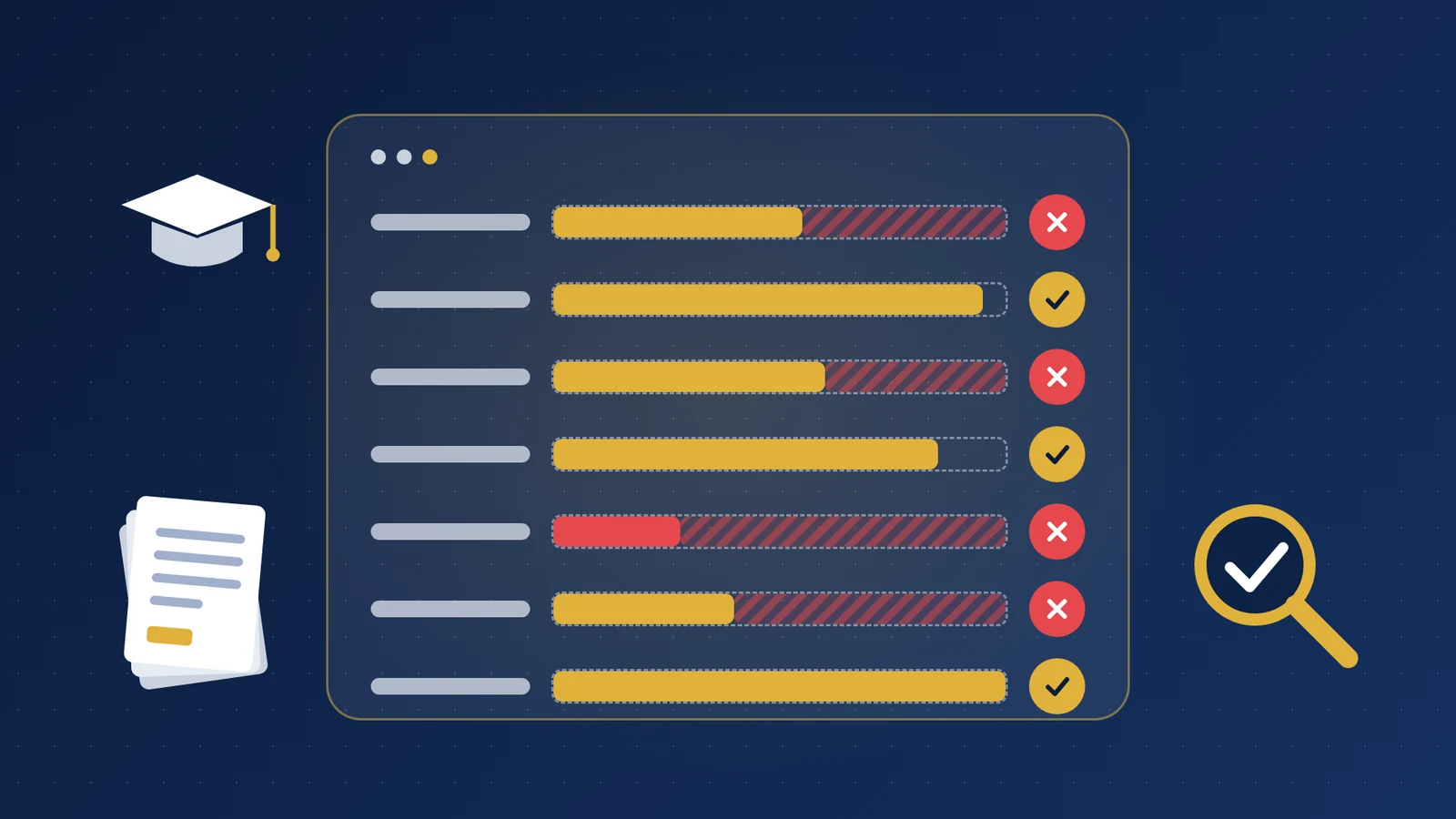
Table of seven subject requirements with one bar shorter than the minimum

Last Updated: October 9, 2026

You converted your CGPA. You cleared APS. Your IELTS is booked. And your application can still be rejected for one thing you have never checked: whether the subjects inside your degree cover what the programme demands, credit by credit.

German engineering faculties do not ask "did you study electronics?" They ask "how many ECTS do you hold in advanced mathematics, in electrical engineering fundamentals, in control theory?" If the honest answer is "not enough," no SOP will save the file. The good news: every requirement is published, in a table, months before you apply.

This guide shows you how to run that check, step by step, and then does it for real with an RVCE Electronics & Communication transcript mapped against RWTH Aachen's M.Sc. Computer Engineering requirements.


QUICK ANSWER: The Credit Table Check in 3 Steps

  1. Find the table: locate the subject requirements ("fachliche Zugangsvoraussetzungen") on your target programme's page and copy each subject, its listed topics and the minimum ECTS.
  2. Match your courses: map every transcript course to a table row, splitting mixed courses by units, and convert credits using the university's own factor (KIT's published example uses 1.2; show 1.5 too, the university decides).
  3. Count the gap: close shortfalls with final-year electives, projects or extra coursework before applying. Conditional admission exists, but it is discretionary, and gaps above 30 credit points can end the application outright.
Why Strong CGPAs Still Get Rejected: The Credit Gap

KIT publishes the most honest page in German admissions: the Computational and Data Science M.Sc. lists its most common reasons for rejection, and not one of them is "CGPA too low." The list reads:

  • Mathematics background not reaching the required scope or depth
  • Insufficient coursework in key subject areas
  • Bachelor's thesis missing or too small in scope (with a blunt note: internships cannot be accepted as an equivalent)
  • Missing module descriptions, which makes it impossible to check equivalence at all

Read that last one twice. Universities reject files they cannot evaluate, not just files that fail.

If you read our anabin check guide, you already know the first gate: whether your degree is recognised at all. Anabin tells you if your degree is valid. The credit table check tells you if it is enough. Most applicants never run the second check. Most rejections happen there.

Want an honest read on your study-abroad plan?

Book a free 30-minute session with Pratik. Know your profile score, program fit, and 90-day roadmap.

✓1,500+ students guided by Pratik since 2012
✓Full refund if a jointly-agreed 3+ university shortlist gets zero offers
✓Direct access to Pratik, same strategist from day one to your visa, no juniors

What a Subject Requirements Table Looks Like

Here is RWTH Aachen's M.Sc. Computer Engineering table in full (English-taught, TU9, published on the faculty's official page):

SubjectMinimum ECTS
Advanced Mathematics25
Physics and electronic devices5
Electrical engineering fundamentals23
Informatics and programming16
Control and systems theory10
Electromagnetic field theory or information theory10
Application-oriented courses20
Total required109
Swipe to view

Two things to notice before you even open your transcript. First, 109 ECTS of named subjects: this is not a vague "relevant degree" requirement, it is an itemised bill. Second, other universities word the same idea completely differently, which is why you must find your programme's own table. The section "Not Every University Uses a Credit Table" below shows two TU9 programmes that do not use a credit table at all.

Step 1: Find the Table

Go to your target programme's page and look for "admission requirements," "Zulassung," or the application supplementary sheet (Antragszusatzblatt). Copy out, for every row:

  • the subject name
  • the topics listed under it (these matter more than the name)
  • the minimum ECTS

Save this as a sheet. One row per requirement. This sheet is the exam paper your transcript is about to sit.

Step 2: Match Your Courses

Build a second sheet from your transcript with: course code, title, credits, and the units or topics the course actually covered.

Two rules make or break this step:

Split mixed courses by units. Indian courses routinely bundle two subjects. In our worked example below, one 4-credit course spends 3 of its 5 units on control and 2 on networks. That is 2.4 credits toward control, not 4. Universities read your syllabus at unit level; so must you.

Convert credits with the university's own factor. KIT's published example states that a four-year Indian bachelor may be regarded as equivalent to a three-year German one, so 150 Indian credits count as 180 ECTS, a factor of 1.2. Some universities use 1.5. Calculate both, submit your best honest mapping, and let the university make the final conversion. It is their decision, not yours.

Step 3: Count the Gap and Close It

Total each row. Every shortfall is one of three kinds:

  • Closeable now: final-year electives, project work, extra coursework you can still add before applying. This is the cheapest fix in the entire application.
  • Closeable via conditions: some faculties admit with conditions, meaning you earn missing credits during the first semesters. RWTH's EE faculty FAQ confirms this exists, but treats it as discretionary, not a right. KIT is blunter: missing credits generally result in exclusion.
  • Not closeable: TU Darmstadt states that conditions above 30 credit points mean the degree is not recognised for that programme. A gap that size is a signal to redirect the application, not to hope.

Run this check for every programme on your shortlist, not just the dream one. The German University Shortlister tiers your overall profile; the credit table tells you which of those tiers your transcript can actually reach.

Worked Example: RVCE Electronics & Communication (2022 Scheme, Semesters I to VI) vs RWTH Computer Engineering

Read this caveat first: semesters VII and VIII of the RVCE 2022 scheme were not published on the department page at the time of writing, so final-year electives and the project can change every number below. This is an illustration of the method, not a prediction of any admission decision.

Conversion shown at ×1.2 (KIT's own example). Control stays short at ×1.5 too (3.6 of 10).

RWTH line (minimum ECTS)RVCE courses counted (credits)RVCE creditsAt ×1.2Result
Advanced Mathematics (25)MA211 Linear Algebra, Calculus and Numerical Methods (4); MA221 Vector Calculus, Laplace Transform and Numerical Methods (4); MA231 Linear Algebra, Fourier Transforms and Statistics (4)1214.4Short by about 10
Physics and devices (5)PY211 Condensed Matter Physics for Engineers (4)44.8On the edge
Electrical engineering fundamentals (23)EC112 Basic Electronics (3); EC233 Analog Microelectronic Circuits (4); EC235 Network Analysis, units 1 and 2 of 5 (1.6); EC244 Signals and Systems (4)12.615.1Short by about 8
Informatics and programming (16)Programming Languages Course (3); EC234 Digital Circuits with HDL (4); EI243 Microcontroller and Programming (4); optional 2-credit MOOC electives (Python and data structures, operating systems, algorithms)11 (13 with one elective)13.2 (15.6)Close
Control systems (10)EC235 Network Analysis and Control Engineering, units 3 to 5 of 5 (2.4)2.42.9Short by about 7
Field theory or information theory (10)EC345 Transmission Lines and Electromagnetic Fields (3); optional EC355 Antennas elective (3)3 (6)3.6 (7.2)Short by about 3 to 6
Application courses (20)EC352 Digital VLSI, EC353 Digital Communication, EC354 Embedded Systems, EC362 SystemVerilog, EC363 Computer Networks, EC364 DSP with ML (4 each)2428.8Covered
Swipe to view

What the table says: this profile covers application courses comfortably and sits close on informatics, but runs short in mathematics, fundamentals and control. The fix is not a better SOP. The fix is choosing final-year electives that pay into those three rows, and adding the EC355 antennas elective if field theory stays a target.

Source of RVCE data: RVCE department page PDFs, 2022 scheme (semesters I and II, 2024 edition; second year dated 29 Nov 2024; third year programme). RVCE's servers block automated downloads; the PDFs were read on 2026-10-09 and the course codes and credits above are copied from them.

The credit and syllabus mapping above is our own reading of the published schemes. Check every course against your own syllabus PDFs.

The Language Catch Nobody Checks

Here is the detail that surprises even prepared applicants: RWTH's M.Sc. Computer Engineering is English-taught, and it still requires German. The faculty FAQ states you must show B1 German, or take two intensive German courses (8 CP) at the RWTH Language Center after arrival.

English gets the offer. German gets the life: part-time jobs, internships, lab conversations, the city outside campus. If your credit table work shows you are 12 months from applying, that is exactly enough time to reach B1. Our German classes in Bangalore run A1 to B2 batches built for exactly this window.

📄

Free Guide: SOP Skeleton & 10 Critical Errors

Download our free 1-page PDF SOP framework used by 600+ students admitted to top global universities.

Documents to Save Before You Graduate

The check above is only possible because the syllabus exists on paper. Before you leave your college, collect:

  • Unit-wise syllabus PDFs with credits, for every course on your transcript
  • Transcript with the grading scale printed on it
  • Thesis or project report, even if the project was small
  • Internship letters (useful, but remember: KIT CDS explicitly does not accept internships as a thesis equivalent)
  • A course-code-to-credits map of your own, built before the college website redesigns and the PDF disappears

One practical tip: RVCE publishes syllabus PDFs per scheme on its department pages. Download the scheme PDF of your admission year today, not the week an application demands it.

Not Every University Uses a Credit Table

The check changes shape by university, which is why step 1 is always "find out how this programme decides." Two TU9 examples from our research:

  • University of Stuttgart, M.Sc. Mechanical Engineering: taught in German (not offered in English). Applicants are scored out of 120 admission points; scores of 80 to 99 are invited to an interview.
  • TU Darmstadt, M.Sc. Mechanical Engineering: requires a bachelor that "does not differ significantly" from its own degree, requires German C1, and runs a two-hour written entrance exam covering seven topics for foreign applicants.

Same country, same field, entirely different gates. If your shortlist mixes universities like these, your preparation must mix too. The how to shortlist German universities guide covers how to build that list, and the admission timeline shows where each check sits in the year.

The Three Mistakes That Break the Check

Mistake 1: Counting a course by its title. "Mathematics for Communication Engineering" sounds like it pays into the mathematics row. Read its units: it is mostly random processes, PCM and signal representation, which belongs to the information theory row, if anywhere. Titles lie; unit lists do not.

Mistake 2: Forgetting to split mixed courses. A 4-credit course that is 60% control and 40% networks is not 4 credits of control. Claiming full credit for a partial match is how files end up in the "missing module descriptions" rejection pile at KIT.

Mistake 3: Assuming a MOOC or NPTEL elective counts. It might. It might not. We found no official statement from any faculty confirming it. If a 2-credit online elective is load-bearing for your gap, email the programme's admissions office before you rely on it.

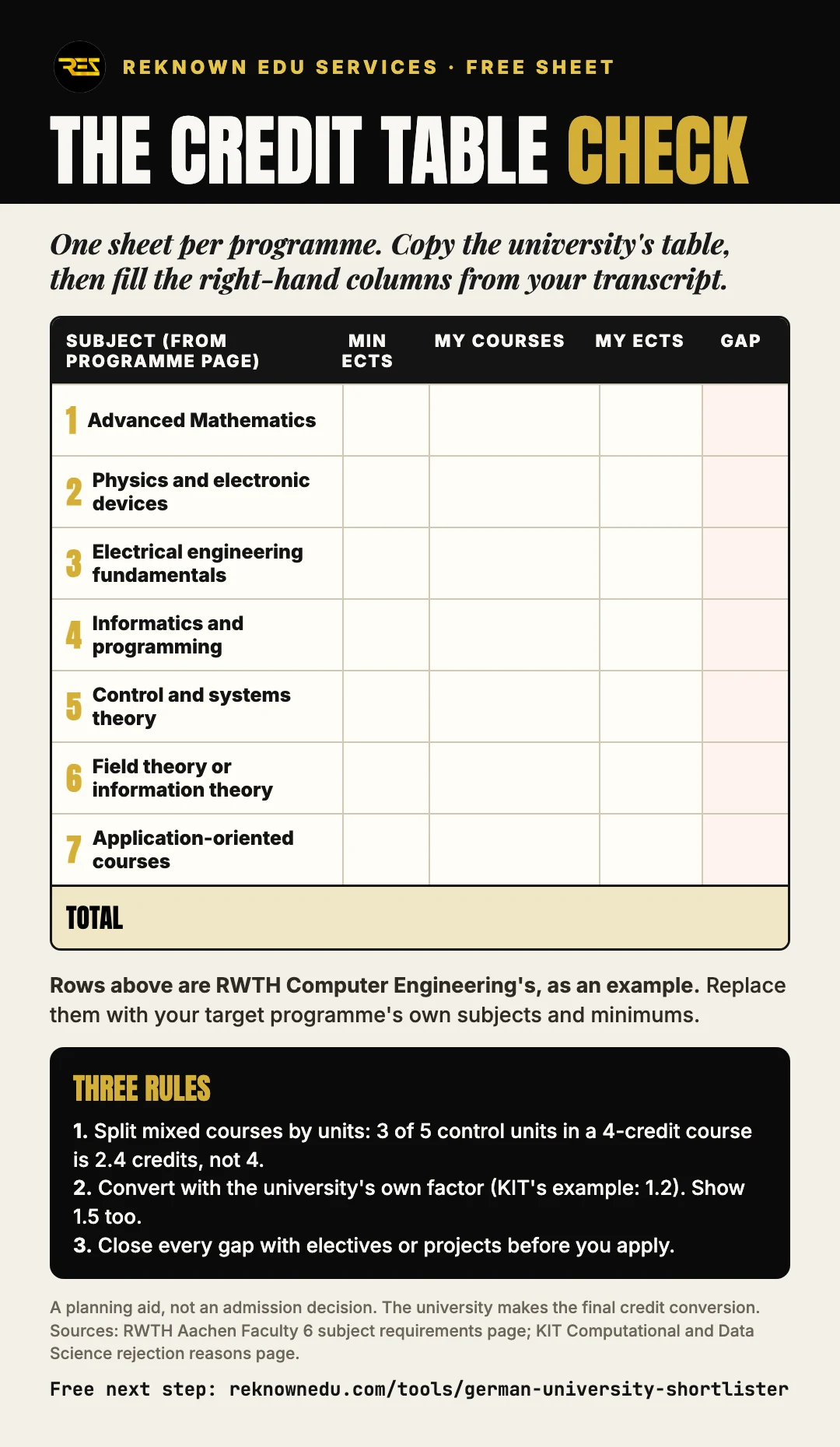
Download the One-Page Credit Table Sheet

Save the sheet below and fill one for each programme on your shortlist. It is laid out like the RWTH table, with columns for your courses, your converted ECTS and the gap.

One-page Credit Table Check sheet: seven subject rows with columns for minimum ECTS, your courses, your ECTS and the gap


Frequently Asked Questions

1. Will my B.E. be accepted at RWTH? No one outside the faculty can promise that, and you should distrust anyone who does. What you can know in advance is exactly where your file stands against the published table, and that is what the check gives you.

2. Which conversion factor should I use, 1.2 or 1.5? The university's, and only the university's. KIT's published example counts a four-year Indian bachelor as equivalent to a three-year German one: 150 credits become 180 ECTS (factor 1.2). Other universities use 1.5. Show both in your own planning, submit your honest mapping, and let the faculty decide.

3. What if I am short by a few credits? Small gaps are sometimes covered by conditional admission, where you earn missing credits in your first semesters. RWTH's EE faculty FAQ treats this as discretionary, and KIT states missing credits generally mean exclusion. TU Darmstadt draws a hard line: conditions above 30 credit points mean the degree is not recognised. Close every gap you can before applying.

4. Does my internship count as my bachelor's thesis? Not at KIT Computational and Data Science. Its rejection-reasons page states internships cannot be accepted as an equivalent to the thesis. If a programme values thesis scope, submit the actual thesis report.

5. Do 3-year Indian degrees qualify for these programmes? Do not guess, and do not average two forum answers. Check your degree's status on anabin first (our anabin check guide walks you through it), then check each programme page individually, because programme-level rules apply on top of national recognition.

6. Do I need German for an English-taught master's? Often, yes, beyond the obvious. RWTH's English-taught M.Sc. Computer Engineering requires B1 German or two intensive courses (8 CP) at the RWTH Language Center. Check the language section of every programme page, not just the medium of instruction.


Honest Limits

  • This analysis is based on published schemes and faculty pages as of 2026-10-09, using RVCE semesters I to VI only; final-year courses can change the worked example's results in either direction.
  • Credit conversions (1.2 and 1.5) are planning estimates. The university makes the final, binding conversion.
  • Universities revise their tables between cycles. Always work from the current page of your target programme.
  • The RVCE to RWTH mapping is our own reading of public documents. Nothing in this post is an admission decision, a visa assessment or a promise of either.

Key Takeaways: The Credit Table Check

  • CGPA opens the file; credits decide it. KIT's published rejection reasons contain no CGPA complaint, only subject gaps.
  • Every requirement is a public table. Find it, copy it, and audit your transcript against it before paying any application fee.
  • Split mixed courses by units, convert with the university's factor, count the gap early while you can still close it with electives and projects.
  • Conditional admission is a favour, not a right. Big gaps redirect applications; small ones get planned around.
  • English-taught does not mean German-free. RWTH asks for B1 on an English degree. Budget the year accordingly.

Next step: know your German grade and your tier before you map credits. Use the free CGPA to German GPA Converter and the German University Shortlister to set your list.


Last updated: October 2026. Sources: RWTH Aachen Faculty 6 subject requirements page and EE faculty FAQ; KIT CDS "Common Reasons for Rejection" (cds.math.kit.edu); University of Stuttgart and TU Darmstadt mechanical engineering admission pages; RVCE 2022 scheme syllabus PDFs (read 2026-10-09). Reknown Edu Services®, Bangalore, since 2012.

Pratik Jain

Pratik Jain

Study Abroad Strategist

Since 2012, Reknown Edu Services® has guided over 8,000 students. Under Pratik's direct leadership since 2016, 1,500+ students have received his personal strategic guidance, personally evaluated, strategized, and accountable.

🎯 1,500+ Students Guided🎓 Strategy-First Approach

Get an honest read on your profile (free)

Book a 30-minute session with Pratik. Know your profile score, program fit, and next 90 days.

So we can send a quick message or voice note.

~30 seconds. A real strategist replies within a few working hours. No spam, no cold calls.

✓1,500+ students guided by Pratik since 2012
✓Full refund if a jointly-agreed 3+ university shortlist gets zero offers
✓Direct access to Pratik, same strategist from day one to your visa, no juniors