Home
How To Shortlist German Universities
Back to Resources

How to Shortlist German Universities in 2026 (Free Tool)

Pratik Jain
How to Shortlist German Universities in 2026 (Free Tool)

Germany has 400+ universities and 22,600+ degree programs. For an Indian student sitting with a CGPA and an IELTS score, that number isn't exciting — it's paralyzing. Which universities will actually accept you? Which ones are worth the uni-assist fee? And which ones look reachable but will quietly reject you for a reason nobody warned you about?

This guide walks you through exactly how to shortlist German universities for the 2026 intake — and shows you how to do it in about 3 minutes using our free German University Shortlister, the same evaluation logic we apply to every Germany applicant we guide at Reknown Edu Services®.
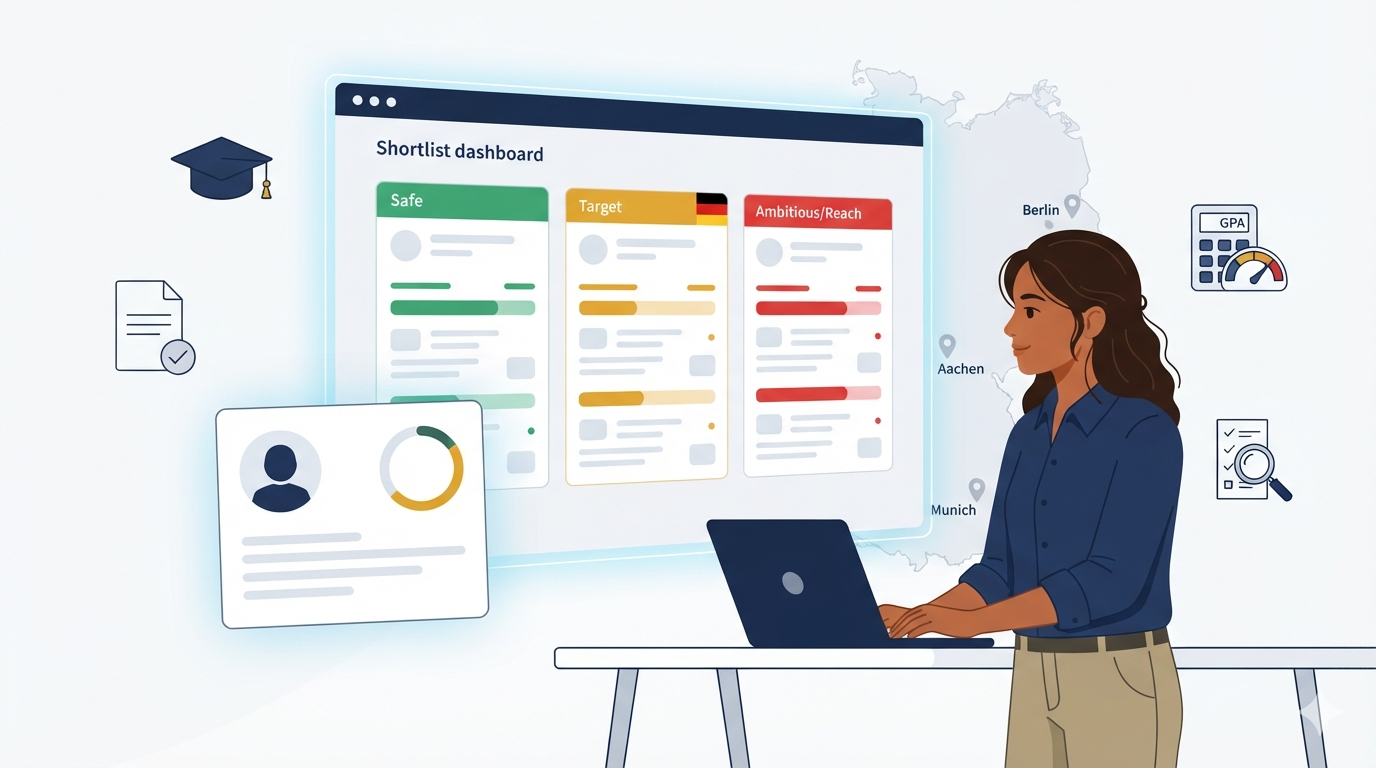
How to Shortlist German Universities


QUICK ANSWER: How to Shortlist German Universities in 2026

  1. Convert your CGPA to the German scale first using the Modified Bavarian Formula (German universities don't read Indian CGPA directly).
  2. Check your degree's equivalence status on anabin — 3-year degrees (B.Sc., BCA) are usually bedingt gleichwertig, 4-year B.Tech is generally gleichwertig.
  3. Map your subject alignment — German programs reject on Fachrichtungsrelevanz (subject competence), not just grades.
  4. Classify programs as NC-restricted or non-restricted — this changes what CGPA is "safe."
  5. Build a balanced list: 3–4 Safe, 4–5 Target, 2–3 Ambitious.
  6. Use the free German University Shortlister to do all of the above against 22,600+ real programs in one pass.

Why Most Indian Students Shortlist German Universities Wrong

Every admissions season, we see the same three mistakes from applicants across India:

Mistake 1: Shortlisting by world ranking alone. A university ranked #150 globally may have a program that rejects 80% of applicants, while a technically "lower-ranked" university admits strong profiles easily. Rankings measure research output, not your admission probability.

Mistake 2: Assuming a high CGPA = safe admission. Germany runs a two-gate decision system, and most students never make it past Gate 1:

  • Gate 1 — Degree Equivalence (anabin / ZAB): Germany evaluates your degree as a whole qualification, not a credit-conversion math problem. A 4-year B.Tech is generally classified as gleichwertig (equivalent). A 3-year B.Sc. or BCA is typically only bedingt gleichwertig (conditionally equivalent) at public universities — and many competitive programs quietly filter these out.
  • Gate 2 — Fachrichtungsrelevanz (Subject Competence): The university's Examination Board (Prüfungsausschuss) checks whether your undergraduate modules match the Master's prerequisite profile. A 9.0 CGPA with the wrong electives gets rejected. A 7.5 CGPA with perfect module alignment gets admitted.

Mistake 3: Applying to 15 random universities. Every uni-assist application costs money, every rejection costs a month of timeline, and every "lottery" application dilutes the quality of the ones that matter. A disciplined 10–12 university shortlist outperforms a scattered 20 every single time.


Want an honest read on your study-abroad plan?

Book a free 30-minute session with Pratik. Know your profile score, program fit, and 90-day roadmap.

1,500+ students guided by Pratik since 2012
Full refund if a jointly-agreed 3+ university shortlist gets zero offers
Direct access to Pratik — same strategist from day one to your visa, no juniors

Step 1: Convert Your CGPA to the German Scale (Before You Shortlist Anything)

Everything in German admissions starts here. German universities evaluate your marks using the Modified Bavarian Formula:

German GPA = 1 + 3 × (Nmax − Nd) ÷ (Nmax − Nmin)

Where Nmax is the maximum grade (10 in India), Nmin is the minimum passing grade (usually 4), and Nd is your grade. The German scale runs 1.0 (best) to 4.0 (pass) — lower is better.

Indian CGPAGerman GPATypical Interpretation
9.0–10.01.0–1.5Excellent — competitive everywhere except elite NC programs
8.0–8.91.6–2.0Very good — strong Target / light Ambitious
7.0–7.92.1–2.5Good — solid Target band
6.0–6.92.6–3.0Workable — focus on Safe + strong SOP
Below 6.03.1+Possible, but shortlist strategy becomes critical
Swipe to view

Do this now: Use our free Indian CGPA to German GPA Converter — it applies the Modified Bavarian Formula instantly, with a full explanation of what your number means.


Step 2: Verify Your Degree's Equivalence Class

Before falling in love with any university, confirm how Germany classifies your degree:

  • 4-year B.E./B.Tech → generally gleichwertig. You pass Gate 1 at virtually all public universities.
  • 3-year B.Sc./BCA/B.Com → usually bedingt gleichwertig. You're eligible, but many competitive Master's programs require additional credits, a pre-semester (Vorbereitungssemester), or simply prefer 4-year degrees.
  • Check your specific university + degree on the anabin database — status can vary by institution.

This single check eliminates 30–40% of unsuitable programs before you spend a rupee on applications.


Step 3: Understand NC vs. Non-NC Programs

German Master's programs admit students through one of two modes:

  • NC-restricted (Numerus Clausus): Admission is competitive and rank-based. Your German GPA is the dominant factor. A 1.3 GPA is gold here; a 2.8 rarely survives the cut.
  • Non-NC (zulassungsfrei): Admission is qualification-based — if you meet the stated requirements (degree equivalence + subject match + language), you're in. Profile enhancers and a sharp SOP carry more weight than a decimal point of GPA.

A balanced shortlist mixes both: NC programs where you compete, and non-NC programs where you qualify.


Step 4: Build Your Safe / Target / Ambitious Structure

The backbone of every successful Germany application strategy:

  • Safe (3–4 universities): Your German GPA comfortably exceeds the program's typical threshold. Admission is highly probable if subject alignment is right.
  • Target (4–5 universities): Your profile sits squarely in the typical admitted range. These form the core of your list.
  • Ambitious (2–3 universities): Below the average admitted profile — but a strong SOP, research papers, or work experience can bridge the gap. TU Munich, RWTH Aachen, and top TU9 programs often live here for 8.0 CGPA profiles.

Total: 10–12 universities. Not 5, not 20.


📄

Free Guide: SOP Skeleton & 10 Critical Errors

Download our free 1-page PDF SOP framework used by 600+ students admitted to top global universities.

Step 5: Run the Free German University Shortlister (3 Minutes)

Here's where you compress Steps 1–4 into one pass. The German University Shortlister evaluates your profile against a proprietary database of 22,600+ actual German university programs, using official anabin standards and German admission criteria — the same two-gate logic described above.

How to use it, step by step:

Step 1 — The Basics. Select your field of study, enter your CGPA (out of 10 — if your college uses a 4.0 scale or percentage, give your best equivalent), and add your IELTS score if you have it. (Don't have IELTS yet? Leave it — the tool still works.)

Step 2 — Your Degree. Indicate your degree type and duration. This is where the engine applies Gate 1: a 4-year B.Tech and a 3-year BCA are evaluated very differently at German public universities.

Step 3 — Subject Background & Profile Enhancers. Tell the engine your subject alignment — this powers the Gate 2 (Fachrichtungsrelevanz) evaluation — then add your enhancers: GRE score, research papers, patents, and relevant work experience. Each one shifts your category boundaries, exactly as German admission boards treat them.

Step 4 — Get Your Report. Enter your email — or skip the form entirely — and get your instant match report: your profile bucketed into Safe, Target, and Ambitious programs, evaluated through the Modified Bavarian Formula and NC/non-NC admission modes.

What you get in the report:

  • Your German GPA conversion (Modified Bavarian Formula)
  • Your Safe / Target / Ambitious program buckets
  • Which gates your profile clears, and where you're exposed
  • A realistic foundation for your 10–12 university shortlist

It takes about 3 minutes. It's 100% free. No cold calls, no spam — just your report and one genuinely useful follow-up email.

👉 Find My University Matches Free →


Step 6: Sanity-Check Your Shortlist Before You Pay Any Fees

The tool gives you probability; your own research gives you fit. Before locking the list:

  1. Read the program's Zulassungsordnung (admission regulations) — every program publishes one, and it states exact module prerequisites.
  2. Compare your transcript modules against the required credit profile. This is Gate 2 in writing.
  3. Check language of instruction — thousands of Master's programs are fully English-taught, but some require German B1 even in "English" programs.
  4. Factor in the blocked account (€11,904/year) and APS timeline — shortlist only what you can realistically fund and document. See our complete APS guide.
  5. Balance across semesters — German programs admit in Winter (Oct) and Summer (Apr) semesters; spread applications so one rejection wave doesn't cost you a full year.

The 2026 Timeline: When to Do All of This

WhenWhat
Now – Oct 2025Convert GPA, run the Shortlister, build your 10–12 list
Oct – Dec 2025APS application, IELTS/GRE final scores, SOP drafts
Dec 2025 – Mar 2026uni-assist applications for Winter 2026 intake
Mar – Jun 2026Offers, blocked account, visa file
Jul – Sep 2026Visa interview, accommodation, departure
Swipe to view

If you're targeting Summer 2026 intake, pull everything forward by ~5 months.


Frequently Asked Questions

Is the German University Shortlister really free? Yes — 100% free. You can even skip the contact form and view your instant match report directly.

Can a tool predict German university admissions accurately? It models the exact frameworks German universities legally use: anabin equivalence, the Modified Bavarian Formula, NC/non-NC modes, and Fachrichtungsrelevanz. Final decisions always rest with each university's Examination Board and uni-assist — but this is the same evaluation logic an experienced consultant applies, available in 3 minutes.

My CGPA is below 7.0. Can I still shortlist German universities? Yes — but strategy matters more than ambition. Your Safe band widens, your Target band shifts toward non-NC programs, and profile enhancers (papers, work ex, GRE) move the needle more. Run the tool and look honestly at the buckets.

Do German universities convert Indian credits to ECTS? No. German authorities judge your degree as a whole qualification (anabin standards). ECTS recognition only applies to individual course transfers where learning outcomes match — it doesn't "convert" your degree.

3-year degree (B.Sc./BCA) — am I eligible at all? Generally yes, but often as bedingt gleichwertig. Many programs admit 3-year graduates; some require extra credits. This is exactly why the tool asks about your degree duration — it changes which programs are realistically Safe.

Does the shortlister cover English-taught programs? Yes — the database spans German public and private university listings across both English and German-taught programs, curated from program regulations and DAAD requirements and updated for current admission cycles.


Key Takeaways: Shortlisting German Universities in 2026

  • Convert your CGPA to the German scale first — everything else depends on it.
  • Germany rejects on two gates: degree equivalence (anabin) and subject competence (Fachrichtungsrelevanz). High CGPA alone clears neither.
  • Structure your list: 3–4 Safe, 4–5 Target, 2–3 Ambitious — 10–12 universities total.
  • Run the free German University Shortlister to bucket your profile against 22,600+ real programs before paying a single uni-assist fee.
  • Verify each finalist against its published Zulassungsordnung — the tool tells you where you stand; the regulations tell you why.

Plan your Germany strategy with a human strategist

Got a complex profile — backlogs, a 3-year degree, gap years, or a sub-7 CGPA? Book a free 30-minute profile evaluation with Pratik. Know public vs. private cutoffs, blocked account rules, APS readiness, and your exact next 90 days.

✓ 1,500+ students guided by Pratik since 2012 ✓ Full refund if a jointly-agreed 3+ university shortlist gets zero offers ✓ Direct access to Pratik — same strategist from day one to your visa, no juniors

Book My Free Profile Evaluation →


Reknown Edu Services® — Bangalore-based study abroad consultants guiding Indian students to global universities since 2012. Part of an 8,000+ student legacy.

Pratik Jain

Pratik Jain

Study Abroad Strategist

Since 2012, Reknown Edu Services® has guided over 8,000 students. Under Pratik's direct leadership since 2016, 1,500+ students have received his personal strategic guidance, personally evaluated, strategized, and accountable.

🎯 1,500+ Students Guided🎓 Strategy-First Approach

Get an honest read on your profile — free

Book a 30-minute session with Pratik. Know your profile score, program fit, and next 90 days.

So we can send a quick message or voice note.

~30 seconds. A real strategist replies within a few working hours. No spam, no cold calls.

1,500+ students guided by Pratik since 2012
Full refund if a jointly-agreed 3+ university shortlist gets zero offers
Direct access to Pratik — same strategist from day one to your visa, no juniors