Home
Germany Semester Ticket 2026 27 Semester Fee Explained
Back to Resources
Germany

Germany Semester Ticket 2026/27: Why It Costs EUR 226.80 and What Else Is in Your Semester Fee

Pratik Jain8 min readLast updated

Listen to this article

Full read-aloud (8 min read) • Text highlights as it speaks

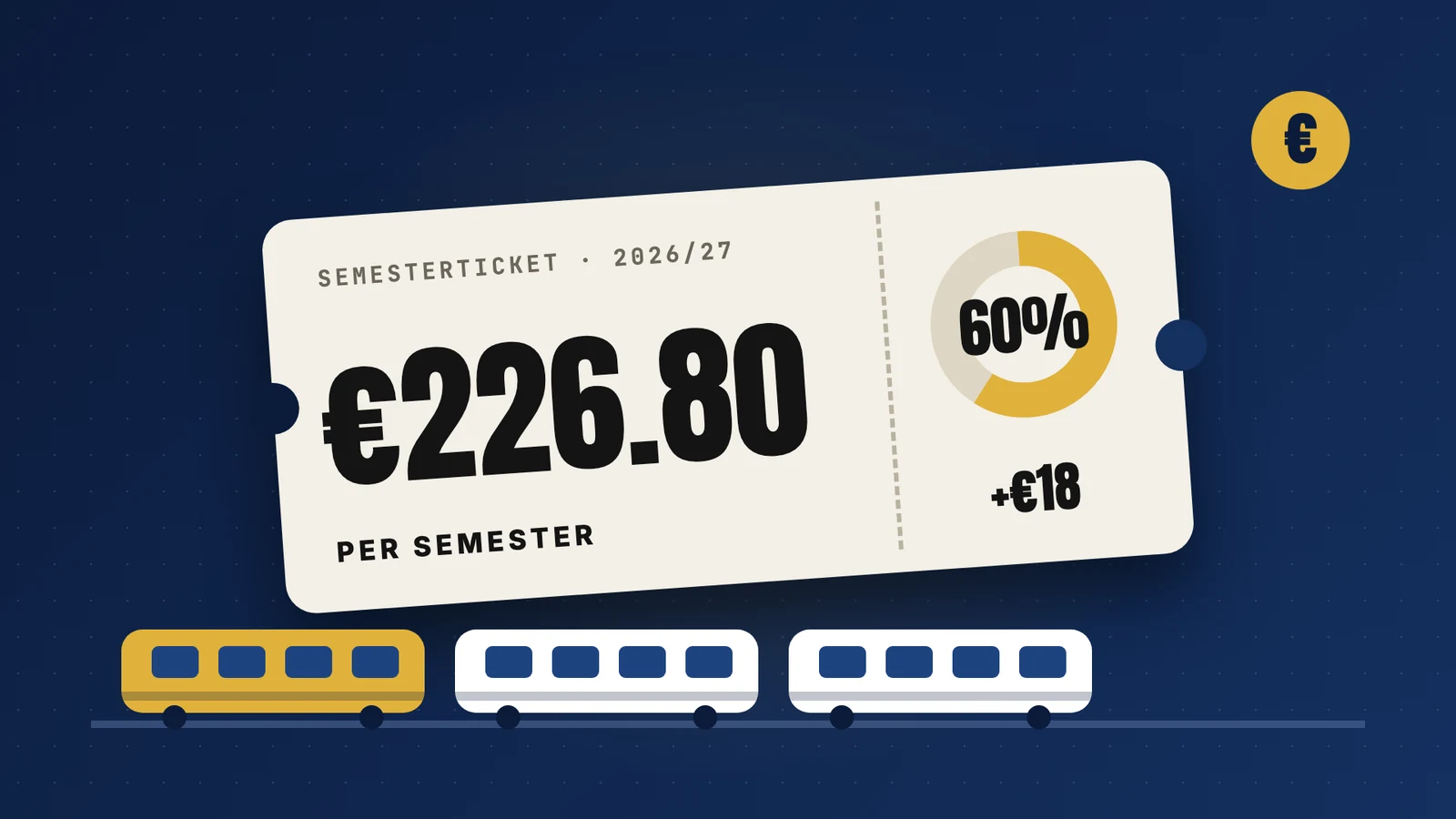
Student semester ticket showing the 2026/27 price next to the 2025/26 price

Last Updated: October 25, 2026

QUICK ANSWER: How much is the semester ticket in Germany for 2026/27? From the Winter Semester 2026/27, the Deutschlandsemesterticket costs €37.80 a month, or €226.80 a semester, because it is fixed at 60 percent of the national Deutschlandticket (€63 since January 2026). At participating universities every student pays it inside the semester fee, used or not. Total semester fees we checked range from €332.30 to €421.43.

Every international student budget for Germany includes the big, famous numbers: blocked account, health insurance, rent. Then a quieter line item arrives with the enrolment letter and surprises almost everyone: the semester fee, and inside it, a ticket you never chose to buy.

From the winter semester 2026/27, that ticket costs €226.80 per semester. This post explains exactly where the number comes from, why you almost certainly cannot opt out, and what else is hiding inside your semester fee.

What changed from Winter Semester 2026/27?

The Deutschlandsemesterticket is now €37.80 per month, or €226.80 per semester, up from €208.80 in the summer 2026 semester. That €18 jump is not a university decision; it follows a national one (see the next section).

Where does this apply? At universities that take part in the Deutschlandsemesterticket scheme. The €226.80 line for winter 2026/27 is already published on the university pages we checked in October 2026: the University of Hamburg (€402 total fee), the University of Giessen (€421.43 total) and the University of Leipzig (€332.30 total, which is lower because its other fee lines are smaller).

Your total depends on the other lines in your university's fee, which differ widely: the same €226.80 ticket sits inside totals from €332.30 to €421.43 in the three pages above. Your university's own page is the only number that matters to you.

All figures in this post come from sources dated June 2026 or later.

Want an honest read on your study-abroad plan?

Book a free 30-minute session with Pratik. Know your profile score, program fit, and 90-day roadmap.

✓Since 2012 · Led by Pratik since 2016
✓Free next intake if an agreed shortlist gets zero offers (terms apply)
✓Direct access to Pratik, same strategist from day one to your visa, no juniors

Why does it cost €226.80?

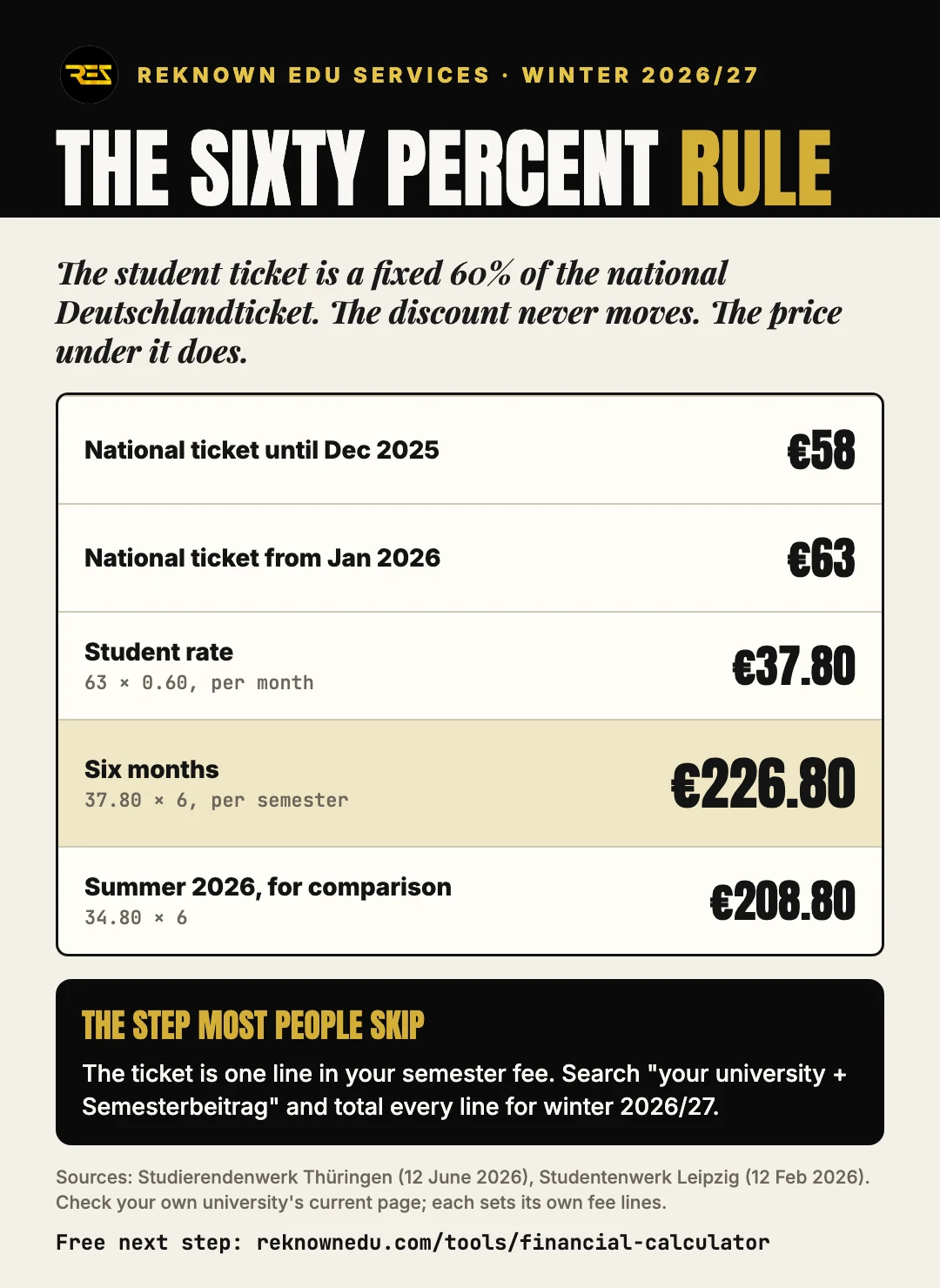
The student version of the Deutschlandticket is pegged at a fixed 60 percent of the national ticket price. Here is the full arithmetic:

StepCalculationResult
National Deutschlandticket, until December 2025base price€58.00
National Deutschlandticket, from January 2026new base price€63.00
Student rate (60 percent of 63)63 × 0.60€37.80 / month
Per semester (6 months)37.80 × 6€226.80
Previous semester, for comparison34.80 × 6€208.80

The Sixty Percent Rule worked out: 63 euros times 0.60 is 37.80 a month, 226.80 a semester

Summer 2026's €208.80 was derived the same way from the old €58 price (34.80 a month). So the "sixty percent rule" cuts both ways: the discount never changes, but the price it discounts does. If the national ticket rises again, your semester fee rises with it automatically.

Can I opt out of the semester ticket?

The ticket runs on a solidarity model: at a participating university, all fee-paying students contribute through the semester fee, whether they ride a train every day or never leave their room. The University of Leipzig states this plainly in its own FAQ: even students who do not use public transport must pay, because the solidarity principle keeps the individual cost low, and exemption is possible only in very narrow cases.

What your €37.80 a month buys: regional trains and local public transport across Germany (S-Bahn, U-Bahn, trams, buses). What it does not buy: long-distance services. The ticket is not valid on DB Fernverkehr (ICE and IC trains) or on FlixTrain and FlixBus.

On a pure value calculation, €37.80 a month for nationwide regional rail is one of the best transport deals in Europe. But "good value" and "optional" are different things, and this one is not optional.

What else is inside the semester fee?

The ticket is only one line. A real breakdown from Studierendenwerk Thüringen, published 12 June 2026 for winter 2026/27:

Line itemAmount
Studierendenwerk (student services) contribution€95.00
Kulturticket Jena€4.25
Kulturticket Erfurt€3.00
Deutschlandsemesterticket€226.80
Service subtotal before student-body fees€321.80

Student-body (AStA) fees vary by university on top of this. Compare that with Hamburg's €402 total (€226.80 ticket, €101 Studierendenwerk, €50 administrative fee, €19.60 student government and a €4.60 ticket hardship fund) or Giessen's €421.43 (the same ticket, €118 Studierendenwerk, €50 administrative fee, €11.50 student body and several smaller lines). The lesson: every university sets its own line items, so two students in the same city can pay noticeably different semester fees. The €226.80 ticket line, though, is consistent everywhere we verified.

How do I read my university's fee page?

  1. Search "<your university> Semesterbeitrag" (use the German term; the fee pages are usually published in German even at English-taught universities).
  2. Pick the right semester: find the winter 2026/27 or summer 2027 table, not last year's.
  3. Check the ticket line: confirm a "Deutschlandsemesterticket" row exists and note its amount, then total every line item for your real first-semester cost.

Do this before your visa interview. "How will you fund your studies?" is easier to answer with the real semester fee in hand, not a guess.

📄

Free Guide: SOP Skeleton & 10 Critical Errors

Download our free 1-page PDF SOP framework we use with our students.

Where does it sit in my monthly budget?

Two posts cover the neighbouring numbers in depth, so we will link rather than duplicate: our health insurance guide (at TK in 2026, €110.38 a month for health plus €35.91 for long-term care, €146.29 if you are 23 or older without children) and our blocked account guide (the official figure is €11,904 a year, €992 a month; verify on the official portal before applying). City-level rent and food numbers live in the cost of living by city post.

Budget lineMonthly figure
Deutschlandsemesterticket (within the semester fee)€37.80
Student health insurance (TK 2026, aged 23+, no children)€146.29
Blocked account monthly release (official)€992.00

Run your full profile through the free Financial Readiness Calculator to see the complete picture for your specific universities.

Limits of this guide

  • Prices move with the national ticket. The €63 national price is the anchor; if it changes, the student rate and your semester fee change with it.
  • Always check your own university's current page. We have verified the €226.80 figure against Thuringia, Saxony (Leipzig), Hamburg and Hesse (Giessen) sources; we have not verified every German state.
  • Participation varies. A university must join the Deutschlandsemesterticket scheme for the line to appear in your fee. We make no claims about universities outside the ones cited.
  • No rent or food numbers here. This post covers the ticket and the semester fee only; living costs vary too much by city to compress into one figure, which is why the city-level post exists.

Want your full first-semester budget?

We add up the semester fee, insurance, blocked account and rent for your actual universities.

Book a free evaluation

Frequently Asked Questions

Is the semester ticket compulsory?

At participating universities, effectively yes. It is bundled into the semester fee under the solidarity model, and exemptions exist only in very narrow cases defined by your local Studierendenwerk. Budget for it as a fixed cost, not an option.

Does it cover long-distance trains like the ICE?

No. The ticket is valid on regional trains (RE, RB and equivalent) and local public transport across Germany. It is not valid on DB long-distance services (ICE, IC) or on FlixTrain and FlixBus.

Why did the price go up?

Because the national Deutschlandticket rose from €58 to €63 in January 2026, and the student price is fixed at 60 percent of it: 63 × 0.60 = 37.80 a month, or €226.80 a semester. The same mechanism will apply to any future national price changes.

Can I just buy the national Deutschlandticket instead?

Our verified sources do not address opting out in favour of the national ticket, and the solidarity model suggests it is not possible at participating universities. For anything beyond that, ask your local Studierendenwerk; they administer the exemptions.

When do I pay for it?

Through the semester fee, either at enrolment (first semester) or at re-registration (every semester after). Your university sets the payment deadline and method, so follow its Rückmeldung instructions exactly; missing it can mean exmatriculation.

Key Takeaways: The 2026/27 Semester Ticket

  • €226.80 per semester from winter 2026/27, up €18 from summer 2026, because the national ticket rose to €63.
  • The 60 percent rule never changes; the price under it does. Expect the ticket line to move with every national price revision.
  • Solidarity model: everyone at a participating university pays, valid on regional rail and local transport nationwide, not on ICE, IC or Flix.
  • The semester fee is more than the ticket: student services, culture tickets and body fees stack on top, and each university sets its own total.
  • Budget it before the visa interview, along with insurance and the blocked account, using the free Financial Readiness Calculator.

Sources

  • Studierendenwerk Thüringen: "Dein Semesterbeitrag für das Wintersemester 2026/27" (12 June 2026)
  • Studentenwerk Leipzig press release (12 February 2026) and University of Leipzig re-registration pages
  • University of Hamburg and University of Giessen semester fee pages (checked October 2026)
  • Uni Erfurt student council Semesterticket pages
  • TK: Student health insurance contributions

Related tools

Pratik Jain

Pratik Jain

Study Abroad Strategist

Reknown Edu Services® has guided students abroad from Bengaluru since 2012. Every plan is personally reviewed by Pratik.

🎯 Guiding Students Since 2012🎓 Strategy-First Approach

Get an honest read on your profile (free)

Book a 30-minute session with Pratik. Know your profile score, program fit, and next 90 days.

So we can send a quick message or voice note.

~30 seconds. A real strategist replies within a few working hours. No spam, no cold calls.

✓Since 2012 · Led by Pratik since 2016
✓Free next intake if an agreed shortlist gets zero offers (terms apply)
✓Direct access to Pratik, same strategist from day one to your visa, no juniors