Home
Ielts Cue Cards With Sample Answers
Back to Resources
IELTS

IELTS Cue Cards 2027 with Sample Answers

Pratik Jain14 min readLast updated

Listen to this article

Full read-aloud (14 min read) • Text highlights as it speaks

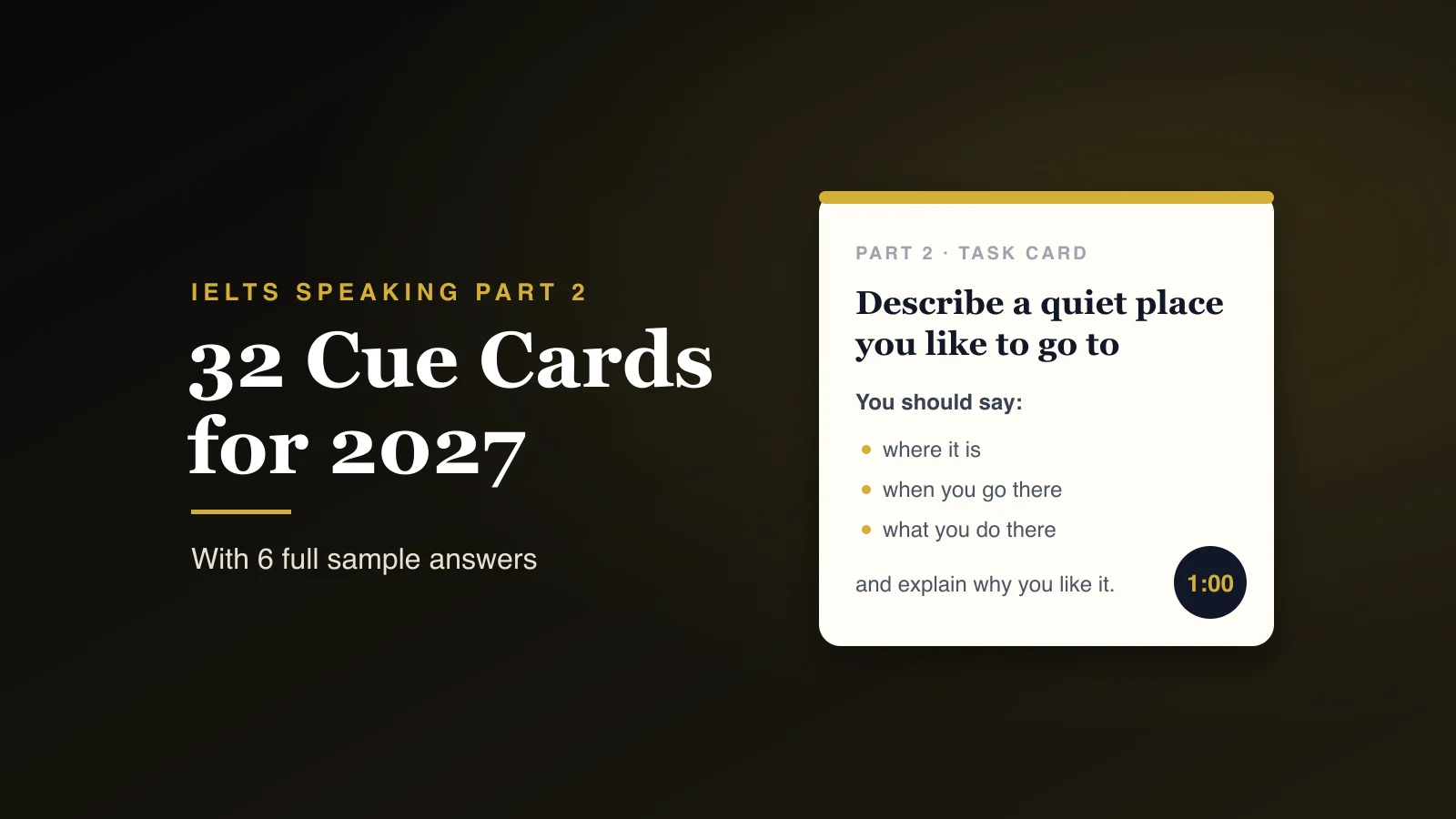
Sample IELTS Part 2 task card: describe a quiet place you like to go to

Last Updated: October 28, 2026

QUICK ANSWER: What is an IELTS cue card? A cue card (IELTS calls it a task card) is the topic you get in Speaking Part 2. You get 1 minute to prepare, with a pencil and paper for notes, then you speak for up to 2 minutes. The examiner may ask one or two questions after that. Below are 32 practice cue cards by theme and 6 full sample answers.

Part 2 is where most candidates either lift their band or lose it. Two minutes feels long when you have nothing planned, and short when you have too much. The fix is not memorised answers. It is a reliable way to use the 1 minute of preparation, plus enough practice on each type of card that nothing feels new on test day.

One honest note before the list: IELTS does not publish the cue cards used in live tests, and no one can tell you the exact card you will get. The cards below are practice cards built on the themes that come up again and again in published IELTS sample material and in what candidates report after their test. Treat them as practice, not predictions.

How does IELTS Speaking Part 2 work?

The examiner gives you a task card with a topic, 3 or 4 points to cover and one aspect to explain. You get 1 minute to prepare and a pencil and paper for notes. You then speak for up to 2 minutes, the examiner stops you when time is up, and may ask one or two short questions on the same topic. Part 2 takes 3 to 4 minutes in total.

The full Speaking test takes 11 to 14 minutes and has three parts:

PartWhat happensTime
Part 1Questions about familiar topics such as home, family, work, studies and interests4 to 5 minutes
Part 2The long turn: one cue card, 1 minute to prepare, up to 2 minutes of talking3 to 4 minutes
Part 3A discussion of wider issues linked to your Part 2 topic4 to 5 minutes

The test is a face-to-face interview with a certified examiner, and it is recorded. Part 3 builds on Part 2: if your card was about a teacher, Part 3 may ask about education in general. So a good Part 2 answer also sets you up for Part 3.

Want an honest read on your study-abroad plan?

Book a free 30-minute session with Pratik. Know your profile score, program fit, and 90-day roadmap.

✓Since 2012 · Led by Pratik since 2016
✓Free next intake if an agreed shortlist gets zero offers (terms apply)
✓Direct access to Pratik, same strategist from day one to your visa, no juniors

How is my cue card answer marked?

Your whole Speaking test, including Part 2, is marked on four criteria: Fluency and coherence, Lexical resource (vocabulary), Grammatical range and accuracy, and Pronunciation. There is no separate mark for covering every point on the card, but a talk that follows the points is easier to keep fluent and organised.

What each criterion means in practice for Part 2:

CriterionWhat the examiner listens forWhat helps in Part 2
Fluency and coherenceSpeaking at a normal speed without long pauses, ideas in a logical order, linking words used wellFollowing the order of the points on the card, with a clear opening and a closing line
Lexical resourceRange of vocabulary, used accurately, and the ability to explain a word you do not knowSpecific nouns and verbs ("a homestay on a coffee estate", not "a nice place")
Grammatical range and accuracyA mix of sentence types, used accuratelyPast tenses for the story, a conditional or two in the "explain" part
PronunciationHow easily you can be understoodSpeaking at your natural pace, not rushing to fit more in

Notice that none of the criteria reward rare words or idioms on their own. A clear, specific story told at a steady pace beats a talk full of memorised phrases.

How should I use the 1 minute of preparation?

Do not write sentences. Write 5 to 8 keywords: one for each point on the card, plus one concrete detail (a name, a place, a number) and one line for the "explain" point. Then speak through the points in order, spend the most time on the story, and finish with your explanation.

This is the method we teach in our IELTS classes. It works because it gives you a route, not a script.

  1. Pick fast (10 seconds). Choose the first real example that comes to mind. A true story is easier to talk about for 2 minutes than an invented perfect one.
  2. Keywords, not sentences (40 seconds). One or two words for each "you should say" point, in order. Add one detail that makes it real: a date, a place name, a number, a smell, a sound.
  3. Plan the ending (10 seconds). Write two words for the "and explain" point. That is your last 20 to 30 seconds and your strongest moment.

A simple time plan for the 2 minutes:

Part of your talkRoughly
Opening: name what you will talk about10 seconds
The first two points40 seconds
The story or detail in the middle40 seconds
The "explain" point30 seconds

If you finish early, do not stop. Add another example ("Another time, I...") or say how you feel about it now compared with then.

Which cue card themes come up most?

Practice cards fall into about eight themes: people, places, objects, events and experiences, activities and skills, media and technology, work and study, and the natural world. If you can talk about one example from each theme for 2 minutes, most cards will feel familiar.

Here are 32 practice cue cards, four per theme. Each card on test day will look like this: a topic, three or four "you should say" points, and one "explain" point.

People

Cue cardYou should say
Describe a person who is very good at their jobwho the person is, what their job is, how you know them, and explain why you think they are good at it
Describe a friend you have known for a long timewho the friend is, how you met, what you do together, and explain why the friendship has lasted
Describe someone older whom you admirewho the person is, how you know them, what they have done, and explain why you admire them
Describe a teacher who influenced youwho the teacher was, what subject they taught, what they were like, and explain how they influenced you

Places

Cue cardYou should say
Describe a quiet place you like to go towhere it is, when you go there, what you do there, and explain why you like it
Describe a city you would like to visitwhich city it is, how you know about it, what you would do there, and explain why you want to visit
Describe a place in your city that has changedwhere it is, what it was like before, what it is like now, and explain how you feel about the change
Describe a public building you have visitedwhat the building is, where it is, what you did there, and explain what you thought of it

Objects

Cue cardYou should say
Describe a gift you gave to someonewhat the gift was, who you gave it to, why you chose it, and explain how the person reacted
Describe something you own that is important to youwhat it is, how you got it, how long you have had it, and explain why it matters to you
Describe a piece of clothing you like to wearwhat it is, where you got it, when you wear it, and explain why you like it
Describe something you bought that you were not happy withwhat you bought, where you bought it, what was wrong with it, and explain what you did about it

Events and experiences

Cue cardYou should say
Describe a time you were late for something importantwhat you were late for, why you were late, what happened, and explain how you felt
Describe a celebration you enjoyedwhat was celebrated, where it was, who was there, and explain why you enjoyed it
Describe a time you helped someonewho you helped, how you helped them, why you helped, and explain how you felt afterwards
Describe a time you changed your mind about somethingwhat it was about, what you thought before, what changed your mind, and explain whether it was a good decision

Activities and skills

Cue cardYou should say
Describe a skill you would like to learnwhat the skill is, why you want to learn it, how you would learn it, and explain how it would help you
Describe a sport or exercise you dowhat it is, when you started, how often you do it, and explain why you keep doing it
Describe a time you learned something new outside schoolwhat you learned, who taught you, how long it took, and explain how useful it has been
Describe a hobby you have had since childhoodwhat it is, how you started, how it has changed, and explain why you still enjoy it

Media and technology

Cue cardYou should say
Describe an app you use every daywhat the app is, what you use it for, how you found it, and explain why it is useful to you
Describe a book or film that made you thinkwhat it was, when you read or saw it, what it was about, and explain why it made you think
Describe a piece of news that interested youwhat the news was, where you heard it, why it interested you, and explain what you think about it
Describe a time technology let you downwhat happened, when it was, what you did, and explain what you learned from it

Work and study

Cue cardYou should say
Describe a goal you want to achieve in the next few yearswhat the goal is, why you chose it, what you are doing to reach it, and explain how you will feel when you achieve it
Describe a project you worked on with other peoplewhat the project was, who you worked with, what your role was, and explain how it turned out
Describe a decision that was hard to makewhat the decision was, when you made it, what the options were, and explain why it was hard
Describe a time you received good advicewho gave it, what the advice was, whether you followed it, and explain how it helped you

Nature and the environment

Cue cardYou should say
Describe a time you spent time in naturewhere you were, who you were with, what you did, and explain how you felt
Describe an animal you find interestingwhat the animal is, where you have seen it, what it is like, and explain why it interests you
Describe something you do to protect the environmentwhat you do, how long you have done it, why you started, and explain whether you think it makes a difference
Describe a time the weather affected your planswhen it was, what you had planned, what the weather did, and explain what you did instead

What does a strong cue card answer sound like?

A strong answer follows the points on the card in order, uses one real example with specific details, keeps going for close to the full 2 minutes, and ends on the "explain" point. Below are 6 full sample answers of about 240 to 260 words each, which is close to 2 minutes at a natural pace.

Read each one aloud with a timer. Then cover the answer, look only at the notes, and give your own version. Your answer does not have to match these. The point is to see how a few keywords turn into 2 minutes of connected speech.

Sample answer: Describe a person who is very good at their job

You should say: who the person is, what their job is, how you know them, and explain why you think they are good at it.

Notes made in the 1 minute: auto driver, JP Nagar, 6 years, school run, knows every shortcut, never cheats, calm in rain.

"I would like to talk about an auto-rickshaw driver in our area in Bangalore. He has been taking my younger sister to school for about six years now, so our whole family knows him well.

On paper, driving an auto sounds like a simple job, but anyone who lives in Bangalore knows it is not. The traffic changes every day, roads get dug up overnight, and in the monsoon some streets simply flood. He seems to carry a live map of the city in his head. If the main road is blocked, he already knows two other ways round, and he has never once been late for the school bell.

The second thing is that he is completely honest. Many people complain about drivers who refuse short trips or ask for extra money. He charges the same fair amount whether it is sunny or pouring with rain, and when my mother once overpaid him by mistake, he came back the next morning to return the money.

So why do I think he is so good at his job? I think it is a combination of skill and character. The skill is knowing the city better than any app, and the character is that he treats the job as a responsibility, not just a way to earn money. Parents trust him with their children, and in my view that is the best measure of anyone who does a job like his."

Sample answer: Describe a quiet place you like to go to

You should say: where it is, when you go there, what you do there, and explain why you like it.

Notes made in the 1 minute: Lalbagh, early morning, Sunday, glass house, walking loop, no phone, birds, before exams.

"The place I want to describe is Lalbagh, the botanical garden in the south of Bangalore. It is a huge public garden, and although it gets crowded later in the day, it is surprisingly quiet early in the morning.

I usually go on Sunday mornings, at around six o'clock, before the city wakes up properly. I walk one long loop around the lake and past the glass house, which takes me about forty minutes. I leave my phone in my pocket on silent, and the only sounds are birds, a few joggers and the gardeners starting work.

I first started going during my final year exams. I was studying late every night and feeling quite stressed, and a friend suggested that a walk before studying might help me concentrate. I was not convinced at first, but after a couple of weeks I noticed I was calmer and I could focus for longer once I sat down to study.

I think I like it for two reasons. The obvious one is that it is green and peaceful in a city that is mostly concrete and traffic. But the more important reason is that it gives me time to think without any screens. Some of my better decisions, including what I wanted to study next, came to me on those walks. So for me Lalbagh is not just a garden, it is the place where I clear my head."

Sample answer: Describe a gift you gave to someone

You should say: what the gift was, who you gave it to, why you chose it, and explain how the person reacted.

Notes made in the 1 minute: grandfather, 80th birthday, old photos, scanned, album, captions, cried, still shows visitors.

"I would like to talk about a gift I gave my grandfather on his eightieth birthday last year. It was a printed photo album of his own old photographs.

My grandfather had a steel trunk full of black and white photos from when he was young, but many of them were fading, and some had stuck together because of the humidity. About two months before his birthday, my cousin and I quietly took the trunk to my house, scanned around two hundred photos, and asked my grandmother to help us with names and dates without telling him why.

We chose the best hundred, cleaned them up a little on the computer, and had them printed as a proper hardbound album. Under each photo we added a short caption, for example the year he joined the railways, or the first scooter he bought.

I chose this gift because he already has everything he needs, and buying him something like a shirt felt meaningless. I also knew those memories were literally disappearing in the trunk.

As for his reaction, he went silent for a long time, and then he started telling stories about almost every page. At one point he had tears in his eyes, which I had never seen before. Even now, whenever a relative visits, the album comes out within ten minutes. I think it was the first time I understood that the best gifts are about time and effort, not money."

Sample answer: Describe a time you were late for something important

You should say: what you were late for, why you were late, what happened, and explain how you felt.

Notes made in the 1 minute: campus interview, final year, metro stopped, 25 min late, ran, HR waited, got offer, now leave early.

"I am going to describe the day I was late for my first campus interview, in my final year of engineering.

The interview was at nine thirty in the morning at a company office in Whitefield, which is on the other side of Bangalore from where I live. I had planned the route carefully: the metro most of the way, then a short auto ride. I left with what I thought was plenty of time.

Unfortunately, the metro stopped between two stations because of a technical problem, and we were stuck for almost half an hour. There was no network inside, so I could not even call to tell them. By the time I got out and found an auto, I knew I was going to be late. I reached the office about twenty-five minutes after my slot, completely out of breath.

I was sure I had lost the chance. But I explained exactly what had happened to the HR person, and she told me the interviews were running late anyway and moved me to the end of the list. I had to wait for two hours, but I did the interview, and a week later I got the offer.

How did I feel? At the time I felt panic and then embarrassment, because I hate being late. Looking back, I feel it taught me two things: always keep a much bigger buffer for important days, and if something goes wrong, be honest straight away. I still leave at least an hour early for anything that matters."

Sample answer: Describe an app you use every day

You should say: what the app is, what you use it for, how you found it, and explain why it is useful to you.

Notes made in the 1 minute: UPI payments app, 2019, friend split bill, tea to rent, no cash, budget feature, scams caution.

"The app I use every single day is a UPI payments app on my phone. I use it to pay for almost everything, from a ten rupee cup of tea at the stall near my college to my share of the flat rent.

I started using it in 2019. I was out for dinner with friends, and when the bill came, everyone split it on their phones in about a minute while I was still counting cash. One of my friends helped me set it up right there at the table, and I have hardly carried cash since.

I use it for three main things. First, paying in shops and to street vendors, simply by scanning a QR code. Second, sending money to friends and family, for example when we share a cab. And third, paying bills, like my phone recharge and electricity, which used to mean standing in a queue.

Why is it so useful to me? The obvious reason is speed and convenience. But the part I value most now is the payment history. Last year I started checking it at the end of each month, and I was honestly shocked at how much I was spending on food delivery. That simple list helped me cut it down.

I should add that I am more careful with it than I used to be. Payment scams are common, so I never approve a request I was not expecting, and I never share my PIN. Used carefully, though, it has made daily life much simpler."

Sample answer: Describe a skill you would like to learn

You should say: what the skill is, why you want to learn it, how you would learn it, and explain how it would help you.

Notes made in the 1 minute: German, Master's plan, A1 then A2, weekend classes, app daily, part-time job, daily life.

"A skill I would really like to learn is German. At the moment I can only say a few basic words, like hello and thank you.

The main reason is that I am planning to do my Master's in Germany. Many Master's programmes there are taught completely in English, so I do not strictly need German for my course. But everything outside the classroom is a different story: talking to a landlord, reading a letter from a government office, or even buying medicine at a pharmacy is much easier if you speak some German.

My plan is to learn it step by step. I want to join weekend classes and aim for level A1 first, then A2, which are the first two levels of the European framework. Alongside the classes, I would practise for fifteen or twenty minutes every day with a language app, mostly while travelling to college, and I would try watching simple German videos with subtitles.

How would it help me? In the short term, it would make my first months in Germany far less stressful. In the longer term, I think it would open more doors. Students who speak some German usually find it easier to get part-time jobs, and if I want to stay and work after my degree, speaking the local language will help me fit into a team.

To be honest, I also just like the idea of being able to understand people around me, rather than feeling like an outsider. So for me, learning German is about my career and about feeling at home."

Two more sample answers (a place you visited and a teacher who influenced you) are in our IELTS speaking topics guide, along with Part 1 and Part 3 practice.

📄

Free Guide: SOP Skeleton & 10 Critical Errors

Download our free 1-page PDF SOP framework we use with our students.

What are the most common mistakes in Part 2?

The most common mistakes are stopping well before 2 minutes, reciting a memorised answer that does not fit the card, spending the whole minute writing full sentences, and skipping the "explain" point. Each one makes it harder to show fluency and organisation.

MistakeWhy it hurtsWhat to do instead
Stopping at 60 to 70 secondsLess speech to judge, and long silences hurt fluencyUse the time plan above. If you run out, add a second example or a "then and now" comparison
A memorised answer bent to fit the cardExaminers are trained to notice rehearsed speech, and it often drifts off topicPractise themes and keywords, not scripts
Writing sentences in the 1 minuteYou run out of time before planning the ending5 to 8 keywords only
Ignoring the "explain" pointYour answer ends without a reason or reflectionPlan your last 20 to 30 seconds first
Talking too fast to fit more inHarder to understand, more slipsSpeak at your normal pace. Two minutes is shorter than it feels

How should I practise cue cards?

Practise one card a day out loud with a timer: 1 minute to make notes, 2 minutes to speak, recorded on your phone. Listen back once and note one thing to improve. After two or three weeks you will have covered every theme in the list above at least once.

A simple 3-week plan:

WeekWhat to do each day
Week 1One card from a different theme each day. Focus only on reaching 2 minutes
Week 2One card a day. Focus on following the points in order and finishing with the "explain" point
Week 3Two cards a day, chosen at random. Focus on specific details and steady pace. Ask someone to give you the card so you cannot prepare in advance

Recording yourself matters more than most people think. You will hear the long pauses and the repeated words ("basically", "like") that you do not notice while speaking.

Want more cards? Our IELTS Speaking cue cards pack has 50+ cue cards with model answers and vocabulary lists in one PDF (₹299). If you would rather practise with a trainer who gives you feedback on every answer, see our IELTS coaching in Bangalore.

Frequently Asked Questions

Are these the actual cue cards used in the IELTS test?

No. IELTS does not publish the cue cards used in live tests. These are practice cards built on themes that appear in published IELTS sample material and in what candidates commonly report. Anyone claiming to have the exact cards for your test date cannot know that.

Can I memorise answers for Part 2?

Memorising whole answers is risky. The card you get will rarely match your script exactly, and rehearsed speech tends to sound unnatural. Prepare examples for each theme and practise turning keywords into speech instead.

What happens if I finish before 2 minutes?

The examiner may prompt you or move on, and you lose the chance to show more of your speaking. Add another example, describe how you feel about the topic now, or compare it with the past to keep going.

Can I make notes during the 1 minute of preparation?

Yes. The examiner gives you a pencil and paper to make notes during the 1 minute of preparation.

Is Speaking the same in IELTS Academic and General Training?

Yes, the Speaking test has the same three-part format in IELTS Academic and IELTS General Training, including the Part 2 cue card.

Does the examiner ask questions after my cue card talk?

The examiner may ask one or two short questions on the same topic after you finish. Part 3 then discusses wider issues linked to your Part 2 topic.

Pratik Jain

Pratik Jain

Study Abroad Strategist

Reknown Edu Services® has guided students abroad from Bengaluru since 2012. Every plan is personally reviewed by Pratik.

🎯 Guiding Students Since 2012🎓 Strategy-First Approach

Get an honest read on your profile (free)

Book a 30-minute session with Pratik. Know your profile score, program fit, and next 90 days.

So we can send a quick message or voice note.

~30 seconds. A real strategist replies within a few working hours. No spam, no cold calls.

✓Since 2012 · Led by Pratik since 2016
✓Free next intake if an agreed shortlist gets zero offers (terms apply)
✓Direct access to Pratik, same strategist from day one to your visa, no juniors